
#3 - OCTOBER 2024

This mega-machine in my head…
Machine? Tool? What we do with artificial intelligence is first and foremost a political choice. And thus a question of sensibilities…
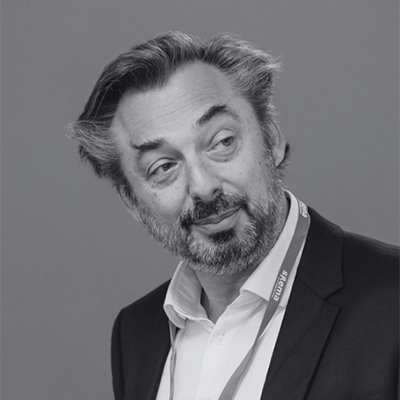
Fabien Seraidarian
Director of Knwoledge Transfer and of the Global Executive MBA, SKEMA Business School
Artificial Intelligence (AI) leaves no-one unmoved. Beyond the apprehension felt by citizens and company employees, it is now the turn of engineering and scientific experts to question the development of AI, its uses and the future of society, especially as regards the advent of “general” or “strong” AI, capable of reasoning and acting autonomously. In today’s world, are technical progress and indeed technology now making history?
In Aristotle’s classical conception, techne is the capacity to make objects with intelligence: the craftsman’s ability to use his skills and gifts to think up and make forms or objects. In contrast with the craftsman’s sensibility, the activity of manufacturing developed and arose from rules, procedures and processes based on a mechanistic representation of nature. Technique makes the craftsman a subject central to the activity of producing, while technology asserts that production is independent of human subjectivity. Techniques are closely linked with the craftsman’s intuition, whereas technologies, a contrario, involve a conscious definition of the rules and principles (the logos of techne) that govern manufacturing processes.
WHERE ARE WE GOING?
The craftsman uses tools to make objects, while operators use machines to carry out production processes. While the tool lends itself to handling and extends the craftsman’s gesture, the machine seeks automatic action more or less supervised by a technician. In other words, it is the individual’s place that is at stake in production: with a tool, the craftsman retains control over his execution and develops his know-how; with a machine, the technician lets the machine work and is no longer central to the production process.
The machine-versus-tool dialectic questions the place of individuals in not only the design and production of objects, but also the creation and distribution of the value created. So, is AI a tool that frees individuals from so-called thankless or repetitive tasks, or rather a machine that fuels fears of ever scarcer work? Beyond that, can it free itself from human intelligence and supervision to function autonomously? Despite the scientific studies and research being carried out, it is still too early to answer these salient questions, which could determine the future of our contemporary world and even our civilisation.
NICK BOSTROM VS. LEWIS MUMFORD
In this context, we are forced to be partisan according to our sensibilities, fears and beliefs, since we cannot establish strong convictions. To inform the debate, we can try to elucidate the thinking of those advocating a cautious attitude to AI by referring to the work of Lewis Mumford, who in 1934 proposed an analysis and critique of technological change as a central factor in the evolution of civilisation. Opposing this critical perspective are those who stand up for AI with regard to the benefits expected, right through to transhumanism, notably defended by Nick Bostrom. The dizzying rise of artificial intelligence has revived the confrontation between these two visions of the world. While its uses were markedly pragmatic with the companies we met, in view of boosting performance (by saving time, improving the quality and results of processes, etc.), the development of applications for employees is also rekindling this conflict, making it diff icult to imagine the impact on society in five or ten years’ time.
Lewis Mumford (1895-1990) was a highly influential American philosopher and science historian who spoke out against the excesses of technological development in industrial society. He introduced the concept of the “megamachine” (1967) to characterise the emergence of the large, complex social organisations that took shape in the first city-states. The megamachine describes society, i.e. a social form that coordinates a huge assembly of symbolic and material resources in an integrated system (see Von Bertalanffy, 1968/2012). For Lewis Mumford, “the megamachine of progress is destroying our ability to pursue autonomous development.”. It refers to increasingly rational organisations, structured by technological systems, creating gigantic interconnected networks. From the industrial revolution to digital transformation and the rise of artificial intelligence, the megamachine has been fuelled by the development of technology.
ESCAPING OURSELVES
A very different point of view is that artificial intelligence serves transhumanist thinking. In companies, the aim is to increase employees’ cognitive and operational capacities and thus boost productivity via applications and tools. AI is becoming the personal assistant we need to do our jobs. Furthermore, the transhumanist perspective goes beyond intellectual faculties and seeks to emancipate humans from their mortal frames – creating greater equality – or, conversely, to achieve greater individual freedom. In any event, technology supports performance at an individual level. Nick Bostrom, a contemporary Swedish philosopher and Oxford professor, is a leading light in Western transhumanism (2021). He considers that technology is neutral before it is used: we need to think ahead in order to avoid the risks associated with its development. This is the idea in his major book Superintelligence (2017), which describes in practical terms how to develop and maintain control of this superintelligence – mainly by ensuring that AI systems are aligned with human values, shored up by a host of concepts like Coherent Extrapolated Volition (CEV), which aims to create an AI that satisfies our most idealised preferences and values.
So – megamachine or superintelligence? It’s up to every person to take a stand on each of the technological changes and breakthroughs governing the development of businesses, now more political than ever in terms of shaping our societies.