
#3 - OCTOBER 2024

Nine questions AI raises for businesses
Because it is a new element in our lives, Artificial Intelligence fills us with a welter of contradictory feelings. It both appeals to us and stirs up numerous questions. We have picked nine of them to reconsider our certainties and perhaps raise other queries.

By Antoine Boitez
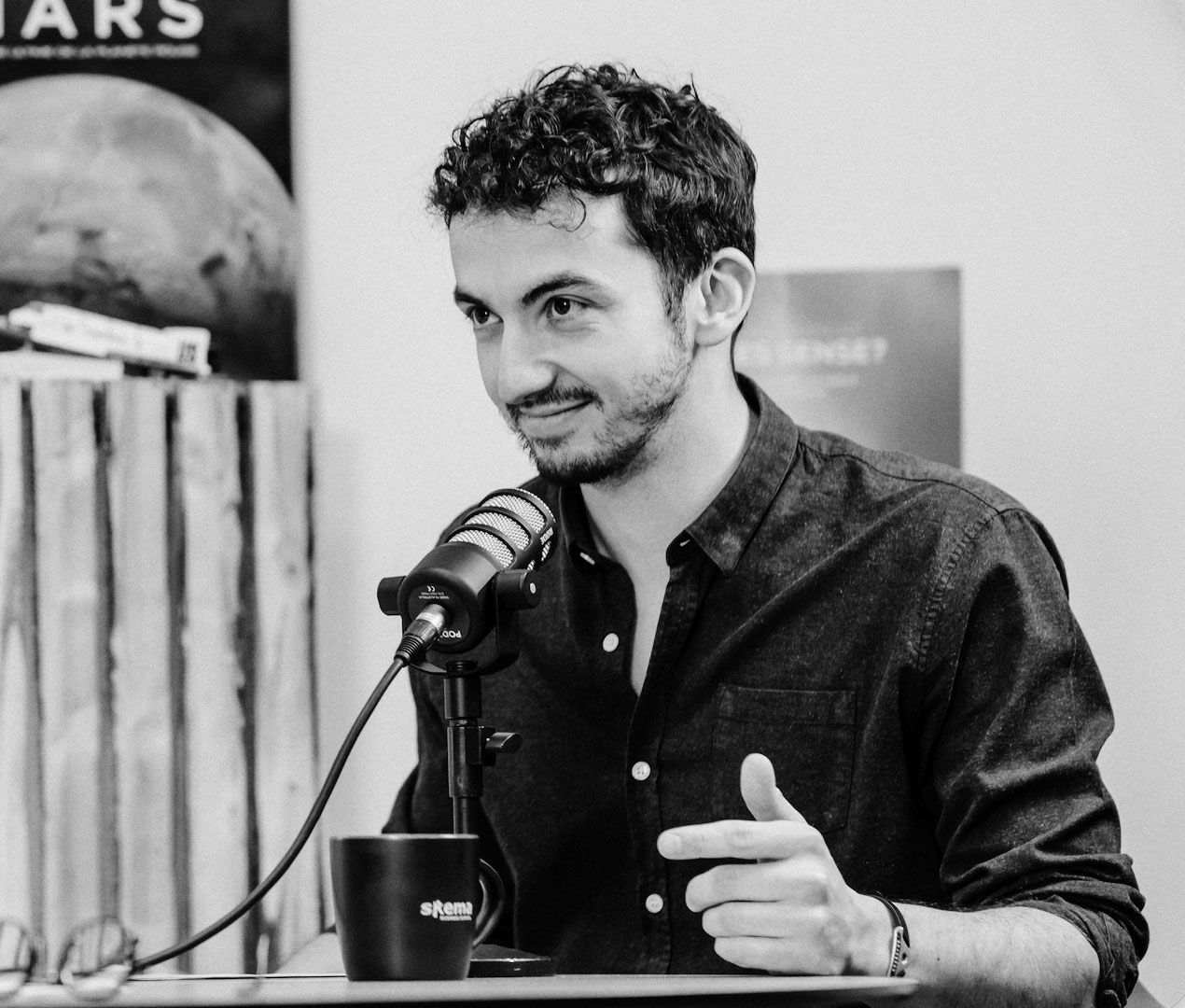
By Kevin Erkeletyan
1.
COULD AI MAKE KPIS DISAPPEAR?
Five days instead of twenty-one. Three minutes instead of an hour. Seventeen seconds instead of six months. A few reports like these are all it takes to get the picture. As the philosopher Luca Paltrinieri puts it, “AI can go where human beings cannot.” In this situation, what will you do with your Key Performance Indicators, those famous KPIs that often guide your business? Do they still have any meaning? Will you still be able to outperform them? To do this, should we be putting AIs, rather than humans, in competition? AI immerses us deeply in relativism. Ironically, it propels the Data-Human into a dimension where statistics sometimes no longer mean anything. Can it then, as we hear, enhance what cannot be measured or only measured poorly? The style of an article, the quality of a speech, the confidence a manager has in his teams – the qualities known as “soft skills”. AI is said to be a creativity enhancer. But how can it be measured? How can it be compared? What if AI makes us focus less on the result and more on how we got it?
2.
WILL THERE BE A GREAT REPLACEMENT?
Are you “white-collar workers” going to be “greatly-replaced” by AI? We don’t want to make you panic, but according to economist Daniel Susskind, this is one of the possible scenarios. AI differs from previous technological revolutions. Not only because it is a generic technology affecting all sectors and professions advancing at breakneck speed, but also because, for the first time, a very wide range of non-repetitive tasks can be automated.
“It’s not like a laptop, which is passive,” says Bernard Sinclair-Desgagné, Emeritus Professor of Economics at SKEMA Business School. “You’re dealing with a technology that you could say is watching you and learning from what you do.” According to a 2023 study by the OECD, the skills in which AI has made the most progress are ordering information, memorising, rapid perception and structuring – i.e. cognitive and non-routine skills, unlike those in which it has made the least progress: hand/arm stability, stamina and static strength.
So, even in the AI pioneering companies we talked to, it raises concerns. The graphic design professions were among the first to imagine a future scenario in which they had no part. At Malakoff Humanis, Jean-Baptiste Girardin also has it in the back of his mind. “That,” he says, “is a use case we worked on for two or three years. “These days, any model can do it. Data scientists are under considerable stress at the moment. Five years ago, it was seen as a job with a future. These days, they are really worried…” The same OECD study also ranks “technical science specialists” among the four professions most vulnerable to AI. Where manual workers were threatened by robotisation, highly skilled employees are now threatened by AI.
“But this doesn’t mean that they will be replaced in the immediate future,” says philosophy professor Luca Paltrinieri. “Work is not disappearing, but it is becoming available to fewer and fewer workers.” According to the Oxford Analytica study, “Automation job gains will be unevenly spread” (2018), “one more robot for every thousand people means around 5.6 fewer jobs across the economy and a wage drop of around 0.5%.” The race against the machine is gathering pace. As Daniel Susskind points out, algorithms and human capital are in competition. New skills are needed in this new digital society, and people are in danger of being left behind. This is one of the two other alternative scenarios to the replacement scenario: the displacement scenario, where AI would not influence the quantity of work available but its quality. In the short term, skilled workers could be forced to fall back on less skilled jobs or jobs unaffected by AI, while human capital adapts to this revolution and ParaAI digital jobs develop again.
This scenario does not contradict the “creative destruction” referred to by Béatrice Matlega: “according to the World Economic Forum, 85 million jobs will disappear but 97 million will be created worldwide.” The Director o fEducation Partnerships and Skills Programmes at Microsoft France is actively lobbying to develop these new skills in young talents: “What’s special about these jobs is that they will hinge on people and algorithms.” White-collar workers (and others) have to adapt. “AI is not going to replace you,” an HR manager regularly reminds his staff. “You’re the pilot; it’s your copilot.” The great replacement, the great displacement… And what if Daniel Susskind’s third scenario won the day? That of continuity: “Business as usual”.
3.
SHOULD AI BE MADE A SPECIAL PARTNER?
Imagine an AI assistant that has assimilated years of data and professional practices, and can help you in your new job. Pierre-Louis Bescond, Roquette’s Director of Data, envisages a (near) future where this assistant could be easily integrated into the host company’s systems, offering unrivalled continuity and efficiency in day-to-day tasks and decision-making processes. He explains: “Let’s take a hypothetical case, where I decide to leave Roquette and I already have a personal AI, which I have trained myself, is used to my style, and has observed my way of working over the last ten years. I arrive at my new company and say to them: how can I hook it up to the company’s new systems so that it can help me on a day-to-day basis?”
Though promising, this concept raises some vital questions: how could the security of sensitive information and data ownership be guaranteed? The idea of a personal, transportable AI assistant could revolutionise the onboarding of new employees in firms. With each person benefiting from their AI throughout their career, professional transitions would become smoother and more productive. “Each employee will be able to have their own Copilot, which means a new way of working with multiple uses,” says Eneric Lopez. Mobile AI could well mark the beginning of a new era, going beyond the borders of each company…
4.
SHOULD WE T ALK TO AI AS THOUGH IT WERE A HUMAN BEING?
“Hey Siri…” From the outset, Apple has got us used to talking to AI as though it’s a person in the room. To trigger this voice interface, which helps you f ind information, you have to say this magic formula, agreeing to be on a f irst-name basis with it. Just like in science fiction. In Interstellar, Christopher Nolan’s heroes chat with TARS, CASE and KIPP, their AI companions, as did the protagonists in Kubrick’s 2001, a Space Odyssey, who speak to HAL in a hostile way.
Closer to our times, Béatrice Matlega has been to a secondary school in Issy-les-Moulineaux (Hauts-de-Seine) to try out an experiment: how would young pre-adolescents of 10 or 11 talk to Copilot, Microsoft’s new “smart” assistant? “They spoke to it very naturally,” says Béatrice, who is overseeing the deployment of new digital skills with the younger generation for the American company. “It was “hello ma’am”, “could you”, “please” and so on. They were very polite and almost humanised this artificial intelligence.”
Of course, ChatGPT, Copilot and Midjourney don’t yet have a name of their own that would make them seem closer to your dog or a person. But for Eneric Lopez, who heads Microsoft’s national AI plan, thinking about how to interact with AI should be part of “basic literacy” where “a certain form of intelligence is restored to us and encourages us to interact with AI very naturally. But behind the facade, it’s still a tool,” he says firmly. It’s a tool that’s going to go on hallucinating, that isn’t an expert in everything, that’s potentially going to provide biased answers.” Be on first-name terms if you like, but always remember that it is not your work colleague.
5.
IS AI JUST ANOTHER OFFICE AUTOMATION TOOL?
Microsoft is integrating generative AI into its everyday office tools, giving every employee a digital copilot. “Each employee will have a copilot and gain from a new way of working on uses that are somewhat basic, and that are going to be extremely useful,” says Eneric Lopez, Director of the National Initiative for AI at Microsoft France.
Here, AI is compared with the introduction of Excel. Just as the spreadsheet transformed working practices in its day, AI is set to become a standard tool in companies. “When the spreadsheet arrived, it enabled us to work differently. We use Excel for everything now… “ But isn’t AI a different animal from the tools in the Office suite? “It’s a different level of abstraction and complexity,” says Eneric Lopez. “It involves using business intelligence, connecting data, getting reports, learning from them, having a fully data-driven organisation, automating a certain number of things, changing your business model, and so on.” AI is not just about practical training. It provides a new collective philosophy, and has an influence on the organisation’s future. “It’s going to affect everyone,’ he continues, “and everyone needs to be able to use it.” This is the mission of Béatrice Matlega, Director of Education Partnerships and Skills Programmes for Microsoft France. “It’s all about having a skills base,” she says. Not just practical training. It’s not about remembering the right formula for adding two cells. AI calls for “increased awareness”, getting to know a new ”language” and the imaginative world it conveys.
6.
WHAT HAPPENS TO THE RIGHT TO MAKE MISTAKES IN A WORLD MISTAKES NO LONGER EXIST?
Since football referees have been equipped with VARs (video assistance referees), they have attracted more criticism than ever. They can decide whether or not to use one, and to make decisions according to the best of their knowledge and belief. The problem is that if they don’t use technology most spectators lambast them, and if they do, they can still make mistakes.
The same problem arises with AI in companies. The difference is that in this sphere, users sometimes have to explain themselves. Allianz France has introduced a number of generative AI tools to “assist” its general agents, helping them to check the rules, and to be quicker and “more on point” if a case is complex. “We provide them with information that helps them make a decision without imposing anything on them,” says Big Data and AI Director Florian Lagardère. But “if they make a decision that differs from what is proposed by our technology, they have to say why.”
This is both proof that “the user is central to the decision,” says Florian Lagardère, and a way for companies to introduce new safeguards. “If someone tries to make a request that goes against good practices, it is automatically blocked; the employee gets a warning and can’t go any further,” says Pierre-Louis Bescond, his counterpart at Roquette. “These mechanisms act as an initial filter.”
While these security measures would be welcomed by many on a football pitch, with a company they raise the issue of removing responsibility. In the stands or elsewhere, technological assistance gives an illusion of certainty. “But AI doesn’t equate with certainty,” says Pascal Bizzari, a partner at AVISIA. “AI is a question of probabilities.” However, the fact remains that a high probability can lull a user into feeling somewhat “comfortable”, to quote Jean-Baptiste Girardin, Lead AI Product Manager at Malakoff Humanis. “People can tell themselves ‘I asked the tool this question and it gave me this answer, so I acted in such and such a way’,’’ continues Pascal Bizzari. “Sometimes we get the impression that people expect us to develop an AI solution to do as little as possible,” says Jean-Baptiste Girardin.
On assignment in call centres, Pascal Bizzari stresses the need to support users in getting to grips with AI products. He cites the example of a software programme that used conversation content in real time to guide advisers, obtain a quick and accurate response and satisfy both customers and advisors, who were “incentivised” by the number of calls handled. “But in real life, they didn’t always use it,” he says. “Not because of the quality of the tool, but because they liked their existing work routine, which had helped them develop know-how and expertise.” Even when assisted by AI, making a decision autonomously also means taking ownership of your position and protecting your self-esteem.
Taking responsibility is good, but making a responsible decision is better. In this “management” between expertise and information, Bernard Sinclair-Desgagné, Emeritus Professor of Economics and Corporate Social Responsibility at SKEMA Business School, sees AI as “a great help” in “supporting” moral decision-making. This is because what is emerging with AI is an attempt to avoid human bias. “But when it comes to moral or ethical decisions, it is ultimately human beings who have to make these decisions,” says the Canadian researcher. “AI is a tool designed to help us,” says Philippe Beraud, Chief Technology & Security Advisor at Microsoft France. “AI can be a powerful tool able to transform the way we work and learn, provided it is designed to take account of people and society. This brings us back to the Pharmakon in Greek philosophy, which has two distinct meanings: medicine or poison, depending on the dosage.” In short, it’s a question of refereeing.
7.
IS IT STILL NECESSARY TO “KNOW HOW TO DO” SOMETHING?
Eight times nine? If you can answer this question without thinking, then you have learned your multiplication tables despite the invention of the calculator, and can do without one despite all its advantages. Otherwise, you have transferred this know-how to the calculator
Today, you can do without AI. But what about tomorrow? Will you still be able to perform the task you’ve delegated to it? “I can’t say otherwise,” says Florian Lagardère, Head of Big Data & AI at Allianz. “When you’re driving a fully-assisted car, you’re a bit less vigilant than when you’re behind the wheel of a 4L.” The car metaphor also speaks to Luca Paltrinieri, a philosophy researcher at the University of Rennes: “Research has been carried out with London taxi drivers. 15 years ago, they knew every street. Today, they use GPS. The famous “knowledge” no longer exists; it’s gone.” Following in the footsteps of the philosopher Bernard Stiegler, he talks of a “loss of knowledge” that could “proletarianise” workers.”
But could this destruction be creative? “Today’s taxi drivers are connected to a collective knowledge,” says Luca Paltrinieri. “Take Waze, for example: a GPS system that embodies social intelligence, with all its users helping to keep us informed in real time. Today’s taxi drivers are cognitive workers.” At Roquette, Pierre-Louis Bescond has not noticed any loss of know-how “for the time being”. But he warns against a form of “easiness” that can arise in the meta-employee: “a loss of critical sense.”
8.
DOES AI REALLY ENABLE US TO CONCENTRATE ON MORE QUALITATIVE TASKS?
We used to know which stores were “essential”, and thus the ones that were not. With the coming of AI, we’re now hearing about secondary tasks, and those that are less so. That’s one of its most highly touted benefits: it frees us from having to write that email we don’t want to write, or having to fill in that spreadsheet that makes our heads hurt. Better still, AI gives our work new worth, giving us a chance to concentrate on tasks with higher “added value”.
Pierre-Louis Bescond cites a good example: “Each month, one person had to generate a whole series of reports based on the data they were given,” says Roquette’s Director of Data. “Thanks to Generative AI, what they used to do in three days now takes half an hour. It freed up their time to analyse the results rather than compile data.” There’s no two ways about it: you not only save time, but can finally do what you never could before. Eneric Lopez goes even further: the director of Microsoft’s National Initiative for AI sees the possibility of both a “rise in competence” and “the heightening of soft skills like empathy, creativity and transversality.”
From the company’s viewpoint, the aim of this delegation is efficiency first and foremost. Technology, validated by the organisation, transcends the employee’s function and revolutionises it. And there’s no turning back. But “it’s not always easy for humans to give up a task they’ve been doing for many years and automate it to AI,” says Nisreen Ameen, Director of the Digital Organisation and Society research centre at the University of London, on ThinkForward, SKEMA’s Knowledge website. “It’s vital to be aware of this, to avoid the high failure rate of AI-related projects in companies (between 83% and 92%).”
What defines a secondary task? Can it be secondary for the organisation but not for the person doing it? Beyond the symbolic value of work, “don’t you have to be good at trivial tasks and do them repeatedly to be good at more important ones?” wonders Bernard Sinclair-Desgagné, a researcher in economics and corporate social responsibility at SKEMA Business School.
Luca Paltrinieri, a philosophy researcher at the University of Rennes, questions the low value of the tasks picked up by AI: “With Large Language Models (LLM), it’s all about creating content. As a result, high added-value activities are also being replaced.”
Part of the answer may lie with Roquette. The French company “worked with” the employee referred to by Pierre-Louis Bescond ”to ensure that the software redid all his operations in his place, and detected various errors that couldn’t be seen.” Can involving employees in the process of replacing their tasks be a form of new, high added-value mission?
9.
SHOULD WE PUBLICISE THE FACT THAT WE’RE USING AI WITHIN A BUSINESS?
Have you seen these photos of Pope Francis in his pure white haute couture puffer jacket? They are the work of Midjourney. AI blurs the lines of thought and meaning. And raises the question of transparency. The social network TikTok, for example, displays the words “AI-generated” when its new avatars appear on the screen. Similarly, Google now labels artificially created images. Meanwhile, lawyers distinguish between the term “exclusively AI-generated works” and its competitor, “works whose creation is AI-assisted.”
And do you inform the recipients of your emails when ChatGPT (co)writes them for you? “Do you need to know?” asks one HR player. “Sometimes I mention it. But does it matter? I’m the one who created the prompt; I’m the one who fine-tuned it. Does this change the dynamic between co-workers? No, I don’t think so.”