
#1 - JANUARY 2024

Separation and reconciliation

Fabien Seraidarian
Director of Knowledge Transfer and of SKEMA Global Executive MBA, SKEMA Business School
The regenerative company: the key ingredient of the planetary doughnut
This is a major movement for companies generating resistance and debate in society. Because what is happening is a break within the dominant paradigm. The doctrine of positivism holds that progress in science comes from accumulating knowledge. But according to Thomas Kuhn, author of The Structure of Scientific Revolutions (1962), it doesn’t work that way. When disorders, anomalies and questions arise and proliferate, a crisis comes about that can lead to a scientific revolution. So a new paradigm that breaks with and contradicts the old one will produce new ways of thinking and replace former ways, becoming the yardstick in turn. This is what is at work in the transition to a circular, regenerative economy, involving transformations that reflect the paradigm shift taking place in practices. As Kuhn points out, the issues at stake in ESG demonstrate the societal aspect of research, underlining the relative nature of knowledge and challenging scientific objectivity.
While regeneration is a paradigm shift for businesses, it also encourages rapid and radical change in organisations and society. The regeneration principle thus goes against the established approaches for building a sustainable or contributive company. These can be seen as progressive, partial and rhetorical, but they are insufficient to tackle climate change and societal challenges in general, according to British economist Kate Raworth and her famous Doughnut Theory (Raworth, 2017): “The doughnut is the compass that should guide prosperity in the 21st century. How can we ensure, as we use our planet’s resources, that no-one is left “high and dry”, without the fundamental things they need to live? But this use of resources must remain reasonable. We need to find a balance between the needs of each individual and those of our planet. Coexisting in this space, within the circular form of the doughnut.” With a capitalism that has become regenerative, the emphasis is on human relationships that are more just, a holistic vision of wealth and the need to adapt and seek balance in a changing context (Fullerton, 2015).
To begin with, the regenerative approach was linked with the circular economy, which is based on the principle of uncoupling economic growth from the consumption of finite resources and the ensuing negative impact on the environment (United Nations, 2011). This principle gave rise to opportunities for companies that reduce their exposure to fluctuations in the price of raw materials, as the resale and recovery of recycled materials is a key part of the circular system (European Commission, 2014). The circular economy fosters improved customer relations and increased customer loyalty (De Rongé & Mossay, 2021).
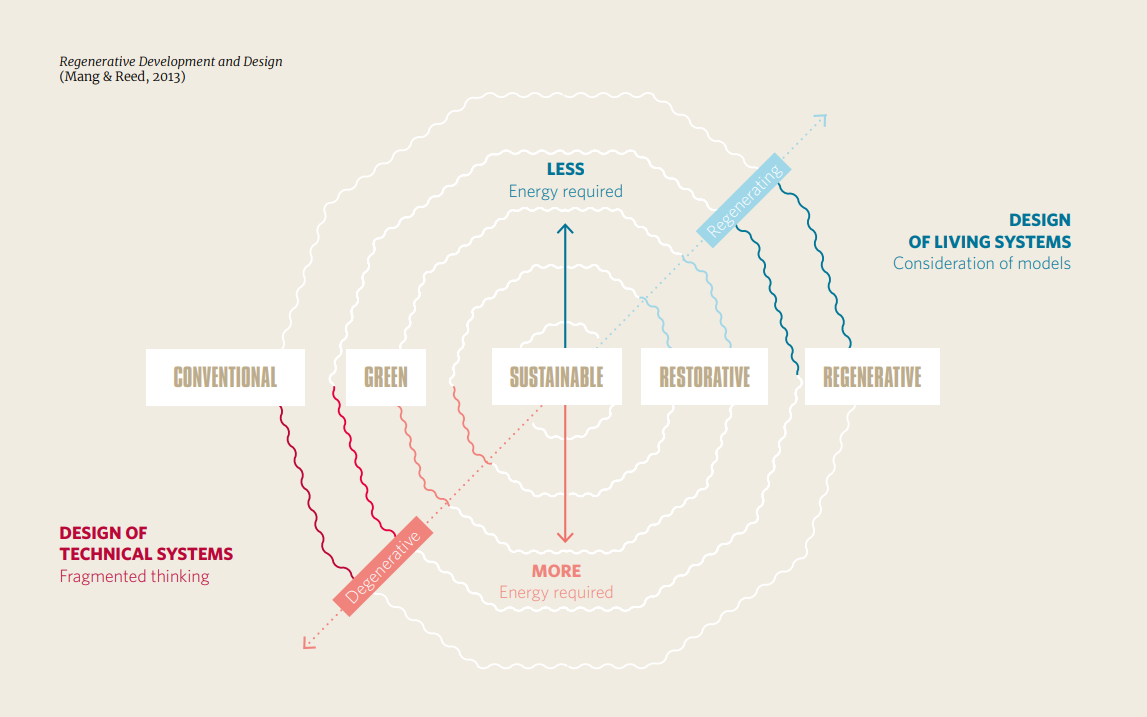
The concept of the regenerative economy also has its roots in the restorative economy popularised over 20 years ago by Paul Hawken, a pioneer of sustainability-focused awareness. The aim of the restorative economy is to restore ecosystems while ensuring prosperity and employment (Morseletto, 2020). It is based on six approaches:
1.
prioritising locally made products,
2.
taking account of the impact on nature,
3.
finding local funding or self-financing,
4.
supporting sustainable production methods that reflect the interests of all stakeholders,
5.
creating products and services whose impact on future generations is factored in right from the design stage,
6.
educating consumers in societal responsibility and environmental impact (Hawken in del Marmol, 2014a).
Click to open image in full screen