
#2 - MAY 2024

Indispensable quotas
What seemed unattainable before quotas has suddenly become so now that they are obligatory. The CopéZimmermann Act proved, if proof were needed, that nothing resists political will. Except for certain realities in the field…

Michel Ferrary
Associate Professor of Management and researcher,
SKEMA Business School
Feminising governance bodies, boards of directors and executive committees is a matter of social justice. It is also a matter of economic performance, as diversity contributes to the efficiency of organisations.
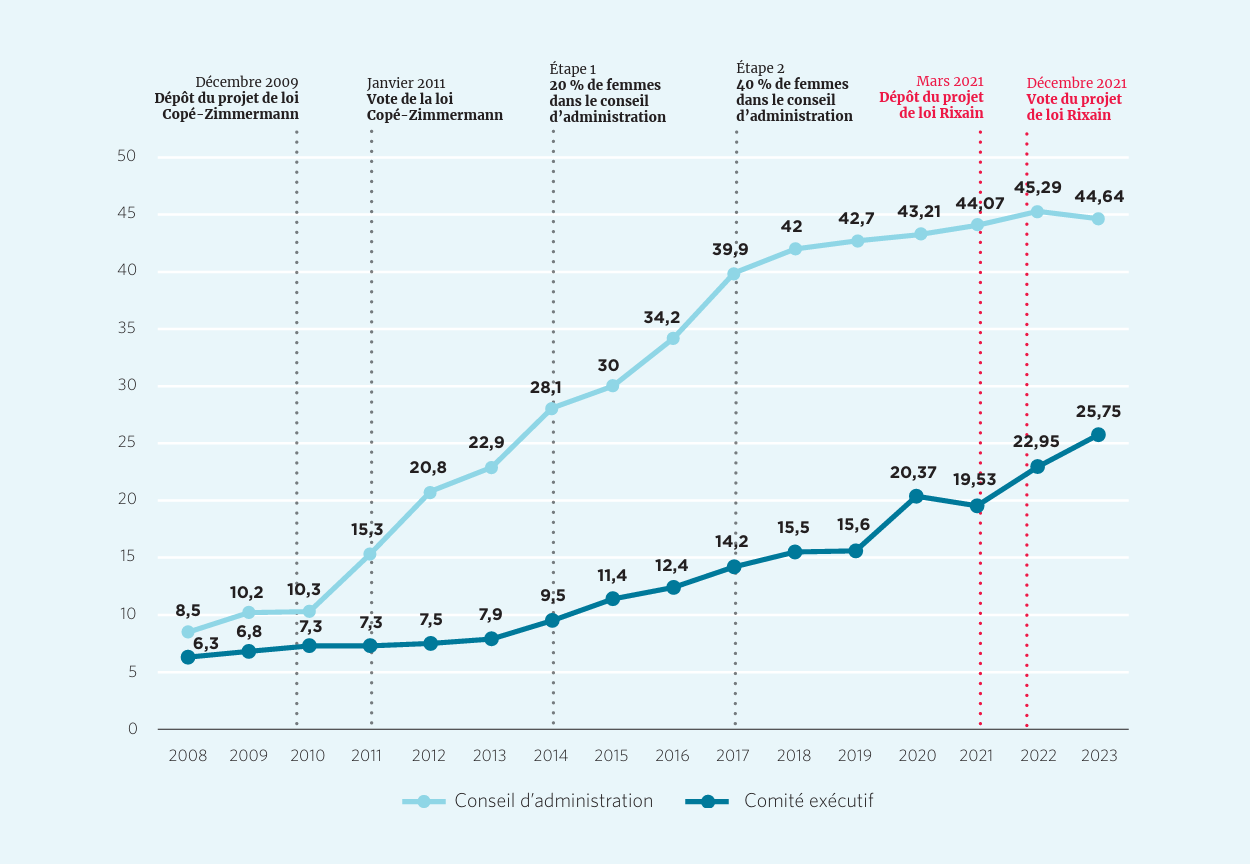
The public authorities in European countries have long been reluctant to legislate to impose binding quotas. They put their faith in social pressure, labour market mechanisms and the “naming and shaming” encouraged by their recommendations and the publication of information. Norway marked the first shift in doctrine from “soft law” to “hard law”. Following recommendations in 2003, in 2006 the Norwegian government made it compulsory for companies to have 40% women on their boards, on pain of dissolution. By 2008, all companies had achieved this quota. Norway’s example inspired other European countries. In 2011, France’s Assemblée Nationale passed the Copé-Zimmermann Act, which required that by 2017, neither gender should represent less than 40% of board members, or the company would face sanctions. This figure was achieved on time (see graph). Compulsory quotas appear to be a necessary lever for promoting gender diversity.
In 2019, given the results of the Copé-Zimmermann Act and noting that the feminisation of boards of directors was not spreading to other corporate bodies, in particular executive committees, the government initiated discussions on new quotas. These discussions led to the Rixain Act, passed in 2021, which requires that women form 30% of executive committees by 2026, and 40% by 2029. Anticipating the law, some CAC 40 companies are starting to feminise this governance body. While the percentage of women on executive committees rose slowly from 6.3% in 2008 to 15.5% in 2018, it has risen sharply since 2019, from 15.6% to 25.75% in 2023.
ASPECTS THAT QUOTAS DO NOT CHANGE
These developments show the importance of legislative constraints in increasing gender diversity. However, the quantitative success of quotas masks their qualitative limitations. The mandatory quotas do not specify the positions concerned. For example, with boards of directors, the act does not specify whether gender diversity must apply to the position of chairperson or responsibility for the various committees, such as “Pay and Governance”, “Finance and Auditing” or “Strategy”. As a result, 95% of the chairpersons of CAC 40 boards are men. Likewise, with executive committees, nothing is specified by the act as regards the post of Chief Executive Officer and the various management positions (finance, production, R&D, HR, sales, etc.). As a result, women rarely occupy the position of CEO and are often relegated to non-operational management positions.
Imposing the same 40% quota on all companies can pose a problem of equity. Companies have very disparate pools of women to promote to their governance bodies. For example, women represent 65% of “engineers and managers” at LVMH and only 16% at ArcelorMittal. It is easier and more equitable to achieve 40% female representation with the luxury group’s executive committee. This is likely to be more difficult to achieve and may seem more unfair to the 84% of men making up the steelmaker’s middle management.
Click to open the image in full screen