
#2 - MAY 2024

The law, companies and what is independent of them
While the law has a decisive role to play in feminising company management committees, it also comes up against stereotypes. In practice, there is a considerable gender bipolarisation in companies. The next stage in including women is through education.
“Nothing can resist the law,” as Michel Ferrary, founder of the SKEMA Observatory on the feminisation of companies, likes to say. And indeed, the Copé-Zimmermann (2011) and Rixain (2021) acts now oblige major groups to initiate or accelerate the feminisation of their management committees. What Michel Ferrary calls the “glass ceiling”, i.e. the difference between the percentage of women on executive committees and the percentage of women managers – the main “pool” of executive positions in companies – has “been almost halved” in CAC 40 companies in 15 years. This difference was over 21 points in 2008, but “only” 11 points in 2023.
As Michel Ferrary has shown, these companies initially had a crafty way of integrating women: until last year, they just added chairs around the management tables! But since this year, the SKEMA Observatory has revealed that women have begun to replace men: the rise in the number of women has been reflected in a relative drop in the number of men.
L’Oréal: the most popular employer with female students
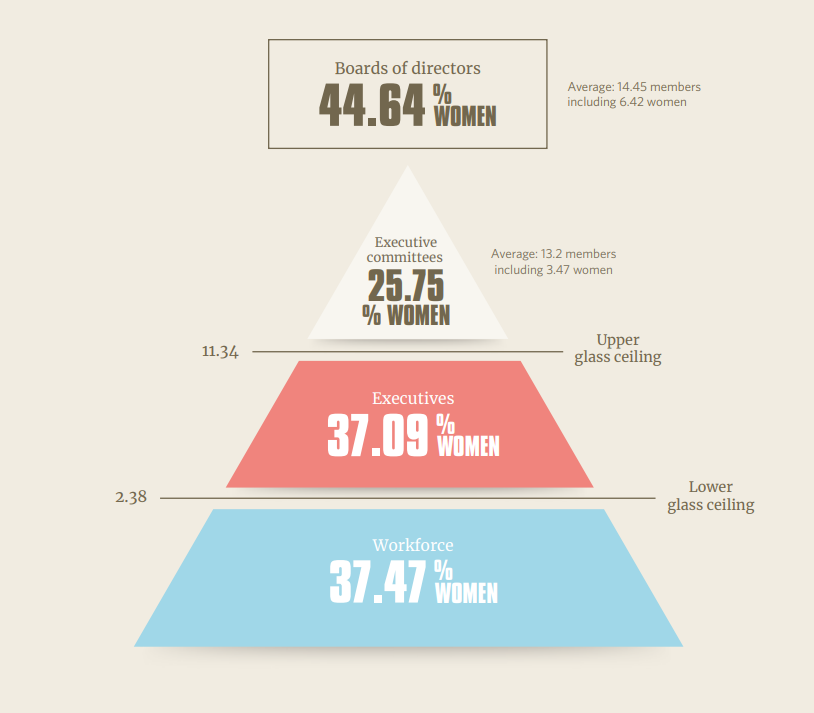
The feminisation of large CAC 40 companies:
legislative leverage and double glass ceiling
Source: 2023 URD of the 40 CAC 40 companies
Click to open image in full screen
“Thanks to quotas, I don’t think there will be any more glass ceilings by 2028,” says Michel Ferrary. But the professor and researcher affiliated to SKEMA goes on to say that while nothing resists the law, “the law can’t do everything.” His analyses, based on data from the annual reports published by CAC 40 companies, also show that gender bipolarisation has existed for many years: companies with the most male employees are increasingly “masculine” and companies with the most female employees are increasingly “feminine”.
“Companies like Thalès, Safran, Airbus and Renault are doing extraordinary things to hire women, but they don’t want to work for them. In management and engineering schools, L’Oréal is the most popular employer with female students and only no. 35 with male students. It’s a matter of education,” says the teacher.
Cécile Lefèvre confirms this, and provides a solution: “When I had to replace the Head of Membership Services, I didn’t get a single application from a woman. Zilch,” says the Vice CEO in charge of HR, CSR and Transformation at the Groupe Pasteur Mutualité. “I put a headhunter on the case and said “find me some women.”” But to no avail. “There’s really some serious work to be done on image and social representation,” continues the woman who was involved in presenting technical professions to secondary school students at France Télévisions. “There are certain jobs that women or men don’t go for.”
Cécile Lefèvre wants women to be “relieved of their guilt”. Karine Lair is right behind her. The CEO of Oasys Dirigeants has seen a number of women who were reluctant to take up an executive position because they thought they were “too fragile”: “they had absorbed the fact that executive positions were maybe too hard for them.” However, “When you’re a manager, you succeed,” she says. “Some women still feel that it means putting their private lives on hold,” says Karine Lair. But “Here, we’ve reached the limit of what companies can do,” says Michel Ferrary.
“I didn’t get a single application from a woman. Zilch.”
Cécile Lefevre, Groupe Pasteur Mutualité
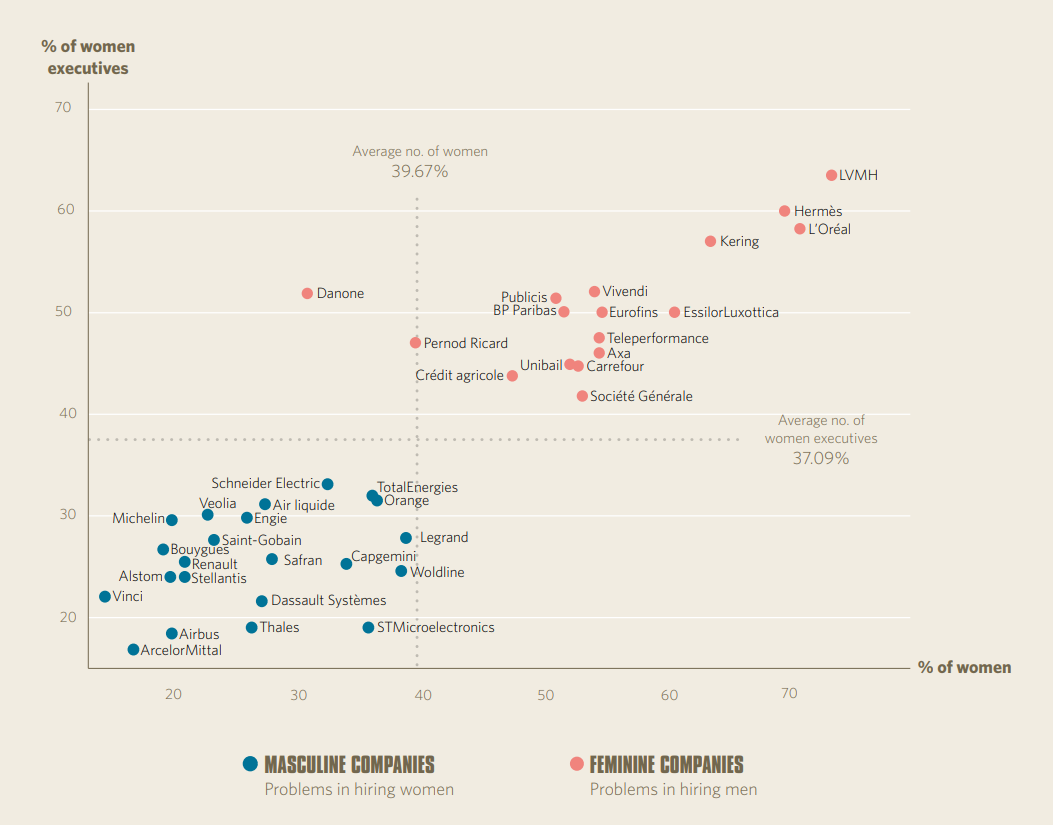
Feminisation of the management and workforce
Gender bipolarisation with companies: the challenge for the education system
Companies with the most male employees are increasingly “masculine” and companies with the most female employees are increasingly “feminine”.
Click to open image in full screen