
#2 - MAY 2024

Authentic leadership: self-transformation serving thewhole
You can’t build yourself up on your own. Authentic leadership is not simply personal development. It comes from a conversation between the deep inner self and the self within the company. A positive dynamic that transforms both the leader and their environment, and creates conditions that foster inclusiveness.

Fabien Seraidarian
Director of Knowledge Transfer and of SKEMA Global Executive MBA, SKEMA Business School
Women’s presence in organisations, hierarchies and governance has been given a boost by legislation. But not all companies start from the same place: numerous contingency factors like the sector, the company culture and the national culture make these regulatory requirements accessible to varying degrees, which means that new strategies and incentives need to be devised. Many of the interviews with women talking about their careers resonate with research that characterises authentic leadership. What came out in the conversations is that leadership requires sensitivity – something that is suggested in the idea of authenticity. We should clarify what authenticity involves, to see how authentic leadership can become a model for organisational development that can move past the often problematic dichotomy between consideration for employees and the need to achieve results.
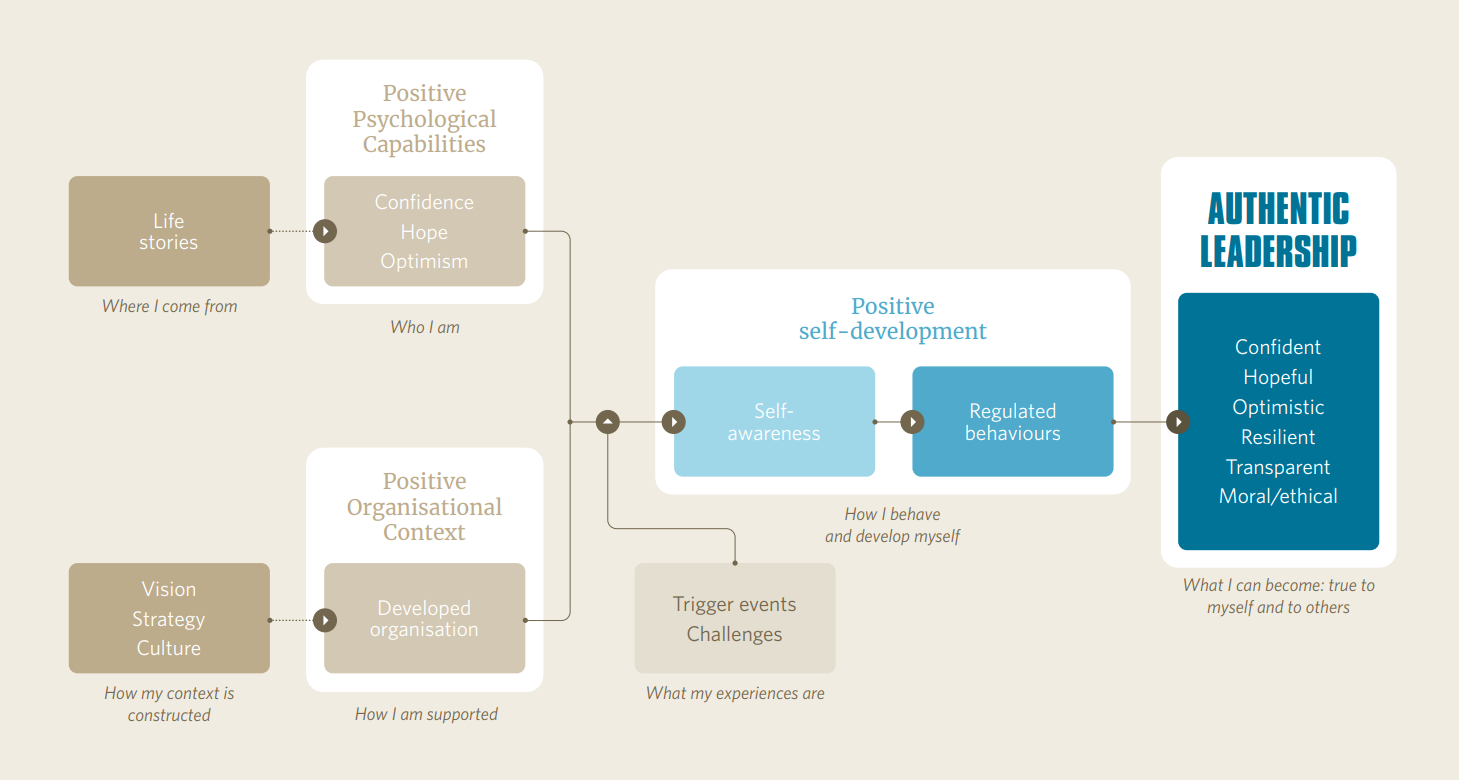
Authenticity refers to two rationales: an existentialist approach that considers individual virtues and ethical choices, and a psychological perspective that looks at individual traits and identities. Among the many definitions, what we see with Luthans & Avolio (2003, p. 243) is that authentic leadership is “[…] a process that draws from both positive psychological capacities and a highly developed organisational context, which results in both greater self-awareness and self-regulated positive behaviours on the part of leaders and associates, fostering positive self-development.” In short, authentic leaders have positive psychological capacities, are self-aware, have positive, self-regulated behaviours and operate in a developed organisational context they help to create.
Being and… Bigness
Women’s accounts of their career development and leadership make it possible to put forward a theory and thereby avoid the gender issue: authentic leadership reconciles personal development – involving awareness of one’s “true self” – with the exercise of responsibilities. It is then an issue of transformation, which involves both an individual approach, based on existentialist and/or psychological perspectives, and organisational development that creates the conditions for exercising leadership and conveys the principles of collaboration to teams. Here we find a recursiveness between the actions of individuals who shape the organisation and an organisation that governs the behaviour of its employees.
So how do you go about practising authentic leadership? According to the existentialist perspective, “to be authentic is to fully realise one’s being-for-others, whatever form that may take” (Lawler & Ashman, 2012). Authenticity is possible if the individual chooses to assume it, encouraging decision-makers to explore personal development. In L’Être et le Néant (Being and Nothingness), Jean-Paul Sartre emphasises the importance of the other in the creation of an individual’s identity: the presence of the other is central to the leader’s understanding of their “being-for-others”. More broadly, the role of the other in constructing the individual and gaining self-awareness is decisive: authenticity is possible only through subjective self-awareness, which in turn depends on the presence of colleagues.
Authentic leaders recognise the importance of dialogue in creating their identity. They build their leadership through communication permitting the organisation’s employees to express themselves and to learn by sharing their views and opinions. From this perspective, taking action on the organisation means working on governance, cross-functionality, team dynamics and the development of commitment through reflection and action alike. In other words, authentic leadership is about rethinking one’s role through one’s presence, rather than exerting control through structures. From an existentialist perspective, an authentic leader makes a conscious choice to assume their existence by confronting situations, despite any problems this attitude entails
A guide to authentic leadership
In the psychological approach, the focus is on self-awareness and self-acceptance in order to construct authentic actions and relationships. Self-awareness is expressed as knowledge of motives, values, desires and cognitions. Self-acceptance means getting to know the self and one’s personal and professional experiences in depth. Self-acceptance means being able to achieve a certain objectivity through reflexivity, and to identify one’s strengths and weaknesses. It involves demonstrating that one’s actions are consistent with one’s “true self”.
Luthans & Avolio (2003) propose a model for developing authentic leadership, using several factors to systematise authenticity in leaders’ practices with regard to their colleagues. Once again, the aim is to bring out the best in individuals in order to serve the general interest:
To sum up, authentic leadership makes it possible to specify the practices embodied by women’s presence in positions of corporate responsibility. While authenticity is a complex concept that distinguishes between existentialist and more psychological perspectives, it involves acting on both the individual and the organisation’s structures. A real transformational dynamic is needed to ensure consistency and overcome a seeming conflict between consideration for employees and issues of performance. At this stage, various levers have been identified: the proximity and presence of leaders, governance practices, the creation of human-scale structures, and more broadly, an organisation conceived as an open system. Authentic leadership is becoming an inclusive approach enabling diversity to be seen as a lever for creating value.
Click to open image in full screen