
#4 - APRIL 2025


Transformation: the future of disenchantment
While change is a natural part of life, transformation aims to restore order. After a difficult adolescence, organisations finally seem ready to realise this vision. Could this be the age of maturity?
By Fabien Seraidarian
Director of Knowledge Transfer and of Global Executive MBA Director, SKEMA Business School
Transforming organisations requires decision-makers to demonstrate humility: many projects fail or reveal the complexity of organisational dynamics. Because organisations are far more than a structure, processes and governance. They have a history and an organisational culture, and numerous contingency factors make them unique. “Ghosts” (Orr, K., 2014) sometimes lurk and influence behaviour and decision-making. But since the late 1980s, companies have learned and matured in their ability to manage change. Echoing this sense of gigantism, we now talk about transformation, which is complicated by size, multiculturalism, technological challenges and disruptions in business models.
Two broad perspectives can be used to categorise organisational change methodologies: planned approaches and emerging approaches.
A PLAN WITHOUT A HITCH?
Change planning and organisational development methods seek to meet pre-defined objectives, often concerning design, operations, management, information systems and practices. The aim is to transition from one organisational structure to another in response to internal or external drivers (new technologies and equipment, growth strategies, sustainability, etc.). In one of the many approaches inspired by Kurt Lewin’s social psychology work in the 1940s, John Kotter proposed an eight-step model for change management. This approach resulted from a study carried out with over 100 companies in the 1990s. This survey concluded that 70% of companies failed in their attempts to manage change due to a lack of methodology. The business environment has become increasingly complex and, despite efforts to learn, the success of transformation processes is still limited and requires an effort to develop competences within organisations, and gain maturity.
Faced with an unstable economic and geopolitical environment and the growing complexity of business management, decisions based on experience and data alone are not enough to take in the acceleration and dynamics of business.
THE RATIONALES OF INTUITION
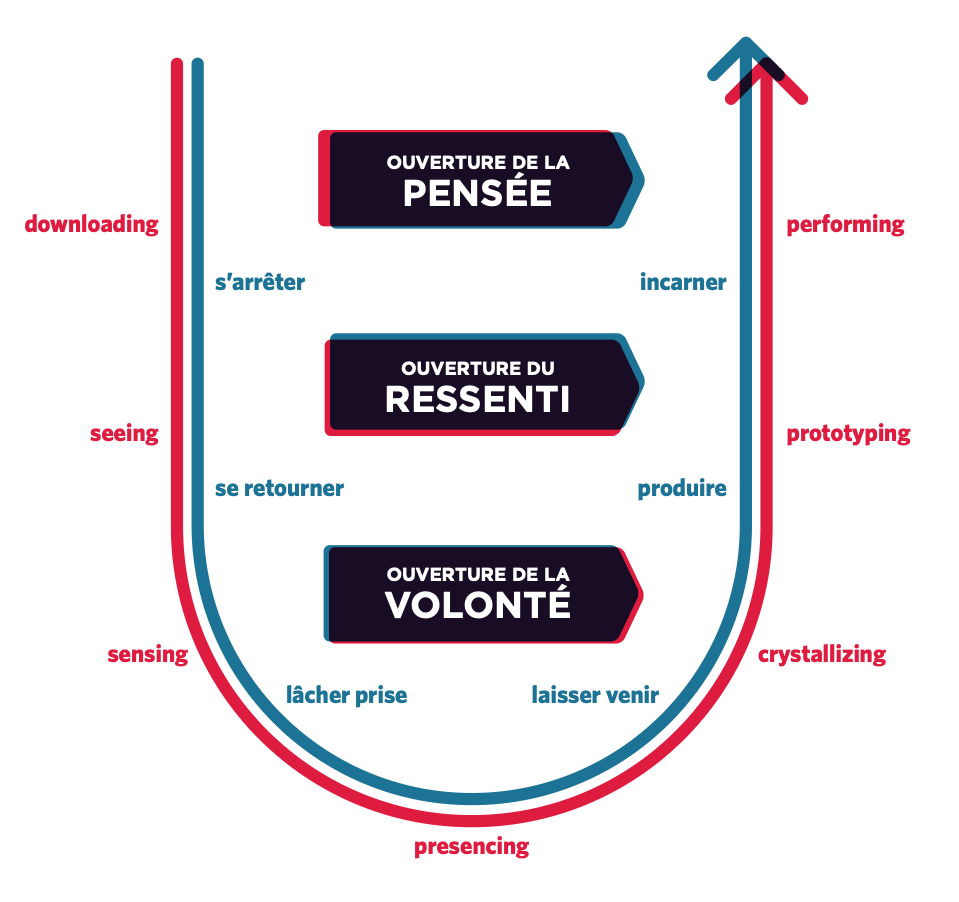
The emergence perspective is different: it primarily seeks to motivate employees, i.e. make them more reflexive and encourage them to develop practices and operating methods with agility, through trial and error. Objectives are thus assessed retrospectively. Otto Scharmer popularised the famous U curve to characterise this iterative approach, which empowers employees to drive organisational development. Theory U is based on openness and intuition, and is part of an approach that combines several rationales:
- Opening the mind: downloading (stopping) to arrive at performing (embodying).
- Opening perception: seeing (turning around) to arrive at prototyping (producing).
- Opening the will: sensing (letting-go) to arrive at crystallising (letting-come).
These three stages contribute to the state of presencing – a mix of the terms “presence” and “sensing” – making it possible to perceive and enable the emergence of a future state of the organisation, a vision, and take a more systemic view. The Theory U is not just a transformation process; it is a leadership and social theory that connects individuals to their environment. It is based on different forms of intelligence: cognitive, emotional, physical, spiritual and creative. Starting from oneself to become part of a collective, this approach acts as a source of intuition and inspiration and constitutes a process leading to co-creation, which can take the form of a prototype (of an organisation, products, etc.).
THE EMERGENCE OF A COMPETENCE
Whatever the approach, the challenge for practitioners is to develop engineering competences to drive change or manage complex transformations. This competence is especially important as it needs to become a common language (change and transformation involve a high degree of cross-functionality) and be formalised within each organisation, through stories, feedback, principles or even a doctrine that enables the sharing of expertise, and guides employees involved in specific projects. Over time, businesses have gained maturity. The case studies presented in this magazine demonstrate the engineering efforts required to structure approaches and embrace organisational complexity.
It is a matter of connecting different dimensions: the integration of technology, developments in business, or growth strategies.
The engineering effort required to conceive and orchestrate large-scale change or transformation should not be underestimated, whether it involves a planned approach or opting for emergence and the mobilisation of stakeholders. Several interpretative frameworks can be used to evaluate how to allocate the necessary resources, strategic exposure, reputational issues, operational management risks and business continuity. And many effects of scale are associated with each situation, whether this be a major need to support the corporate fabric in the light of past traumas (planned redundancies, industrial failures or successes), a significant investment in order to innovate and introduce disruptions in the business model (e.g. product reliability), or the importance of involving customers to reassure them, or highlight an organisational model or new services and provide information about them.
Two interpretations make it possible to identify the engineering challenges involved. Firstly, considering the ambition and attitude of the players involved in order to assess the transformational issues. Secondly, assessing the strategic issues and the involvement of stakeholders. This will help guide engineering efforts. Several characteristics stand out in case studies: the introduction of a transformation office reporting to senior management to coordinate projects and provide expertise to decision-makers; a strong focus on developing leadership, and the conceptualisation of strategic issues and the transformation process.