
#5 - NOVEMBER 2025


Benjamin Ferré, alone with the world
He never experienced globalisation as powerfully as he did in the very spot on the planet where he was most alone. Benjamin Ferré (SKEMA 2015), 16th in the 2024 Vendée Globe and f irst in his category, takes us on board his yacht to show us his point of view: that of a man of the world, in the very truest sense.
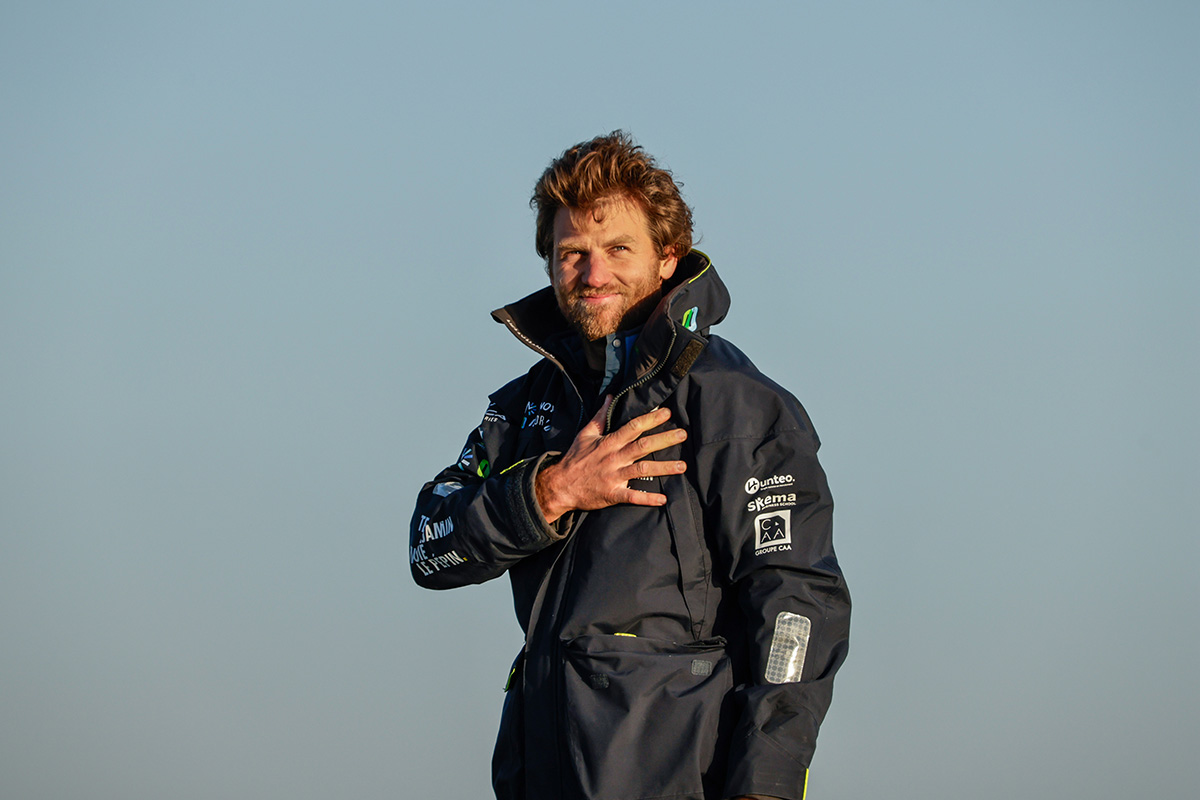
By Benjamin Ferré
Sailor and entrepreneur
The world may not be turning smoothly, but the main thing is that it’s turning! As I type these lines on my computer keyboard, it has been exactly 48 hours since I crossed the finish line in the last of the five stages of the Ocean Race Europe: a crewed sailing race that connects cities and cultures; an invisible line that links shores, peoples and histories. From Kiel to Genoa, Cartagena to the Bay of Nice and Portsmouth to Porto, every stopover was a cultural epic. My latest sailing adventure reminded me of something essential: before becoming an economic concept, globalisation was always a human business.
My name is Benjamin Ferré. I’m an ocean racing sailor, I graduated from SKEMA in 2015, and I’m a devoted lover of our little blue planet! I’ve had the opportunity to go around the world twice. The first time I was 20, when I hitchhiked 40,000 kilometres around the globe, passing through 26 countries. The second was six months ago, when I completed my first Vendée Globe in 84 days, 23 hours, 19 minutes and 39 seconds.
GLOBALISATION AT POINT NEMO
I have always believed that adventure is the best way of learning about the world. It forces you to understand the risks, adapt to the unexpected and collaborate with very different personalities. It confronts you with yourself in the silence of the open sea, during tumultuous storms or sailing the swells of the southern oceans. And in my view, this precisely involves one of the greatest contradictions of our time: we live in a world that is increasingly connected, but often feels disconnected from what really matters.
When I discovered the topic I’d been given a chance to think about today: “Globalisation: “Stop or carry on?”, it immediately reminded me of a few notes I’d scribbled on some waterproof notebook paper, leaning on the chart table of my boat during the Vendée Globe:
“Here, beyond the Roaring Forties, I realise that nature has no memory or scruples. It buffets me or cradles me, careless of my energy, origin, resistance, physical condition, fatigue, gender or skin colour. Here, nature treats everyone on an equal footing. I have this strange, utopian feeling that if we sent all the leaders of this planet on an immersion course at 48 degrees south, 123 degrees west, the humanity resulting from this experience would resolve all global conflicts. I no longer intellectualise the concept of everyone belonging to the same place; I just feel it deeply. I am at Point Nemo, the point furthest from any land, and yet I’ve never felt so close to my fellow human beings!”
When sailing solo around the world, you are competing against other sailors – and, paradoxically, if something happens to you, only another competitor may be able to come to your rescue if you get into trouble, given our geographical position. This solidarity among seafarers, despite the intense competitiveness driving us and this quest for the Holy Grail – a victorious journey around the world – may be hiding the key to successful globalisation
CHANGING COURSE
Globalisation also involves navigating an ocean of uncertainties. We live in a changing world, where adaptability has become a vital quality. To go back to the essentials of sailing, the 5-point rule applies when the environment is unstable: Keeping on course, adjusting, tidying up, eating, resting. As in ocean racing, globalisation must return to its first love when the weather turns bad: bringing peoples together!
It is not a question of “stopping” or “carrying on”. It’s about doing an about-face, changing course, accepting that infinite growth on a finite planet is a dead end. Yet the spirit of adventure itself is infinite. That’s what drives us to innovate, communicate, explore, grow, meet new people, learn in order to understand more clearly, and take an interest in things to help us accept. And this spirit can also inspire us to invent a different kind of globalisation: one that is gentler, more grounded, more humane.
Globalisation is not just a GPS that works everywhere. It’s also a sense of urgency: urgency as regards the climate, identity and recreated meaning. On board, water is life! It’s my energy; my life jacket. Every watt consumed is counted, every meal is weighed, and moderation is a must. These constraints create value. And this moderation could become a source of wealth on land. A form of deliberate, joyous, bold “de-growth”.
It would involve rethinking globalisation on a human scale. Where you can buy locally but think globally. Where projects have a soul. Where companies dare to make room for emotion, be vulnerable and pass on their knowledge.
I don’t believe in uniformity; I believe in making bridges. Every sailor charts their own course around the world, and leaves a part of their history in their wake. The same is true of countries, peoples and economies. I believe in large, productive differences.
So, globalisation: stop or carry on? Carry on, but in a different way. Carry on, but with awareness. Carry on, but with a different approach. Not with unthinking speed, but with a sense of true meaning. With an unseen impact. The legacy we leave behind.
A globalisation of connections, not a mere flow.