
#5 - NOVEMBER 2025


Olivier Grohmann
“VERY FEW COMPANIES
ARE TRULY
Global”
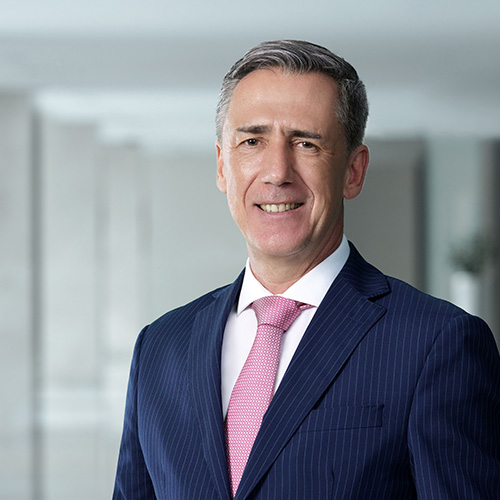
He has worked in Europe and Asia for companies with operations around the world, but it wasn’t until Oliver Grohmann moved to Dubai that the Executive Vice President of Human Resources at the Emirates Group truly understood what globalisation means.
Olivier Grohmann
Executive Vice President of Human Resources at the Emirates Group
Joining the aviation industry in 2019, just months before COVID—was that a miscalculation about globalisation?
Wasn’t it? (laughs) And yet, just yesterday, I received messages from former colleagues saying how wise I had been to leave the automotive industry a few years ago. European carmakers are having a tough time. They dismissed electric vehicles just as Tesla and Chinese companies jumped in. They were slow in adopting, and now they’re scrambling to catch up.
But 18 months into COVID, I really felt foolish. It was an extremely difficult time—our aircraft were grounded, and for the first time since Emirates was founded in 1985, we had to let people go. Once the worst of the pandemic was behind us, we haven’t stopped growing. Things change fast; the world is so volatile. Just look at today’s geopolitical tensions around the globe…
During the crisis, you managed to stay the course.
Exactly. We made a bold decision: not to listen to the consultants who told us people would never travel again and that we should park our aircraft in the desert or sell it. We chose to keep the entire fleet, initiated full network recovery one destination at a time, and that’s what allowed us to become stronger much faster than many other airlines after the crisis.
Was that also thanks to Emirates’ uniquely multicultural environment in Dubai (see also: p 28-31)?
Absolutely—it makes us more agile. I’ve lived and worked in Germany, Singapore, and South Korea for multinational companies, but this is the first time I’ve experienced a truly global culture. Elsewhere, companies claimed to be “global,” but their way of working was entirely rooted in their home-country culture. At Mercedes in Singapore, local staff complained that our German expatriates often spoke German among themselves. And when two French or two German colleagues meet abroad, they instinctively speak their native language. There’s no ill will in that.
But it’s deeply ingrained in corporate culture, and it inevitably makes things less smooth. At LG Electronics in Seoul, most meetings were conducted in Korean. I relied on a team of interpreters and often felt like an outsider. In most countries where LG operated, the key roles were held by Koreans. Do you really believe a Korean executive knows the French market better than a French one? Very few companies are truly global. That’s globalisation’s glass ceiling.
A ceiling that Dubai and Emirates are breaking through…
Yes, and it happens naturally thanks to Dubai’s unique environment. In the executive team, I know the colleague next to me is British, German, or Emirati, but honestly, it doesn’t matter. We all speak English.
But beyond language, it’s about mindset. And that’s something you build over time, through experience. My children grew up in Singapore and South Korea, and studied in Australia and the Netherlands. They started out “German-German,” but over time, they became true citizens of the world. They consider themselves as “third culture kids”—children who sometimes struggle to reintegrate into their home country, and don’t fully belong to Korean or Singaporean culture either. My son shares an apartment with another student. I asked him where his roommate was from. He said: “I don’t know.” He does not care; he has a truly global mindset.
Very few people live that reality. To attract top talent to Emirates and immerse them in this culture, we focus on a balanced approach that values people just as much as technology. We begin onboarding them even before they arrive (see also : Emirates: a vision takes flight).
Olivier Grohmann
AT A GLANCE
1994
Becomes a lawyer
1999
Joins Daimler AG in Berlin as Vice President, Head of International Assignments, Policy & Consulting
2006
Becomes Head of Human Resources at Mercedes-Benz Bank AG.
2012
Moves to Singapore as Senior Vice President HR for Mercedes in Southeast Asia.
2015
Recruited by LG Electronics in South Korea to lead HR for all international operations.
2018
Appointed Head of Global Human Resources at Hyundai Capital International, South Korea
2019
Joins Emirates as Senior Vice President HR Business Partnership at dnata, one of the world’s leading global air and travel services provider.
2024
Promoted to Executive Vice President Human Resources at the Emirates Group and appointed to the Board.