#5 - NOVEMBER 2025


Overview
Globalisation can be deeply unjust, unfair and unequal — but these are things we can control. The market economy is not unnecessary; on the contrary, we need it. However, it must not take precedence or dominate other institutions.
Amartya Sen, Nobel Prize in Economics
Slowbalisation will be tougher and less stable than the globalisation that went before. In the long run, it will only fuel discontent.
The Economist, cited by Foreign Policy in Focus (2019)
THREE EXAMPLES OF
SUCCESSFUL
GLOBALISATION
Siemens, a European multinational investing in smart relocation
With a presence in over 200 countries, Siemens has successfully combined global expansion with regional roots. The group is developing local production units to meet the challenges of industrial sovereignty, particularly in Europe and the United States, while remaining a key player in the energy transition.
Haier: when a Chinese manufacturer rethinks internationalisation
Haier has not only exported its products; it has also acquired brands (including America’s GE Appliances) and incorporated local talent and expertise. It has thus combined globalisation with an in-depth adaptation to Western markets, becoming a model of “glocal integration”.
Google: controlled technological globalisation
Google certainly exemplifies a form of controlled globalisation: the group has established itself as a global digital infrastructure (with its search engine, Android, YouTube, Google Cloud, etc.) while adapting its services to increasingly strict regulatory frameworks. Google has developed a localised deployment strategy, opening cloud regions in each strategic zone (Europe, Latin America and Asia). It also relies on sovereign partnerships, as with Thales in France, to provide reassurance on data security issues.
THREE EXAMPLES OF
FAILED
GLOBALISATION
Walmart in Germany: exporting without listening and inevitable failure
By transposing its American model with no cultural or managerial adaptation, the retail giant failed to establish a lasting presence in Germany. Its blindness to local customs, social pressure and misunderstandings within the company all led to years of losses, and Walmart withdrew from the market in 2006.
Target in Canada: confusing speed with haste
The American retailer opened over 100 stores in Canada in under two years, without testing its market penetration. The result: stock shortages, poor localisation, consumer frustration and a deficit of over $2 billion. In 2015, Target left the market. Proof that internationalisation is not at all a matter of copy and paste.
Ever Given (2021) – A container ship; a blockage; a warning signal
When a giant container ship ran aground in the Suez Canal, 12% of global trade was halted for six days. Just this one incident was enough to disrupt global supply chains, highlighting their extreme vulnerability. Obsessed with optimisation, the company disregarded the resilience factor.
IT HAPPENED IN
2013
CHINA CHARTS
ITS OWN COURSE
By launching the ambitious Belt and Road Initiative, Beijing fundamentally reshaped the flow of infrastructures, capital and influence around its own national priorities. This project marked the emergence of a focus on multipolar globalisation, moving away from the Western model.
2016
THE UX
CHOOSES BREXIT
The protest came from within. In 2016, the United Kingdom decided to leave the European Union. This unexpected decision, based on a popular vote, ushered in an era of regional disintegration, challenges to transnational agreements and mistrust of the free movement of goods and people… and common rules.
2022
SEMICONDUCTORS BECOME
BECOME A STATE ISSUE
The US CHIPS and Science Act brought about the return of industrial protectionism. With massive subsidies, strategic relocations and secured supply chains, globalisation was now redefined in terms of technological sovereignty.
World
Trade
which in 2022 represented
62,8
%
OF GDP
DROPPED TO
58,5
%
IN 2023
World Bank, 2023 data
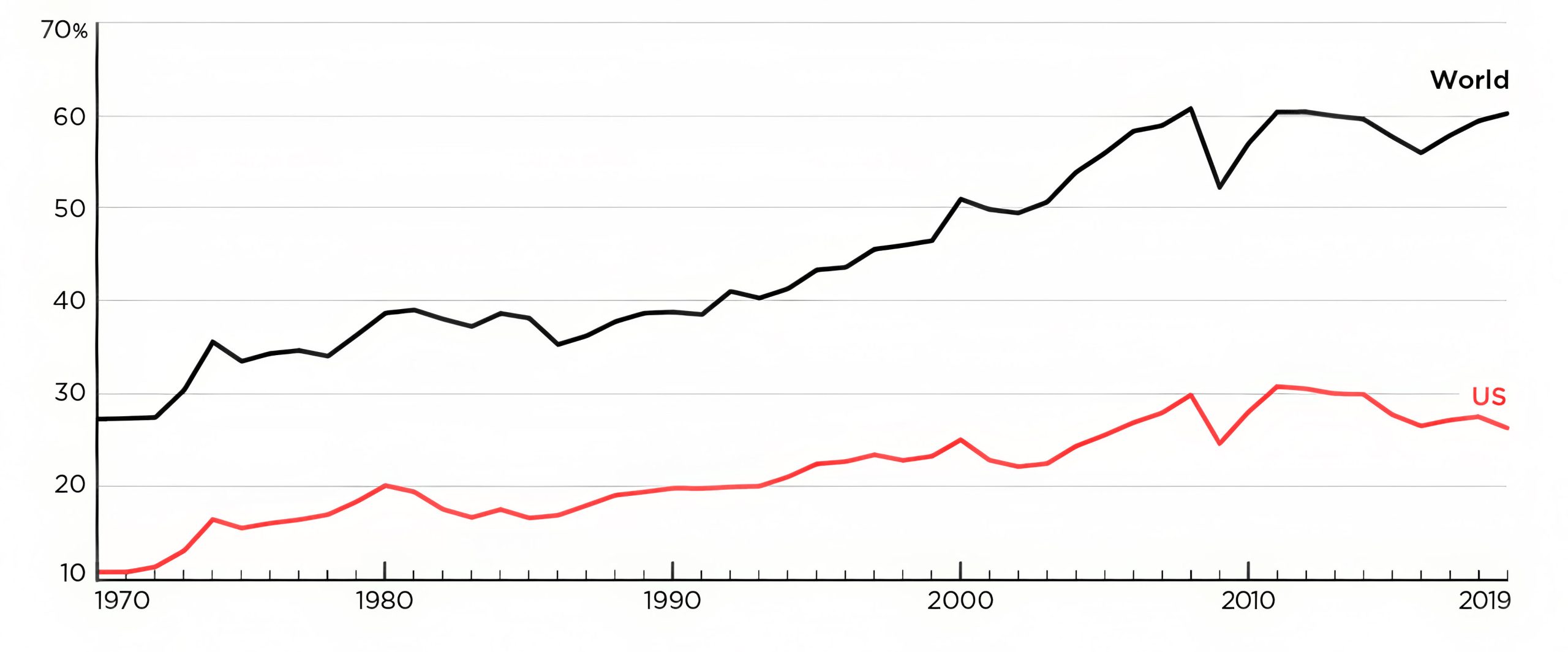
THE UNITED STATES’ TRADE OPENNESS DID NOT FOLLOW THAT OF THE WORLD IN GENERAL
TRADE IN GOODS AND SERVICES
AS A PERCENTAGE OF GDP, 1970-2019