
#1 - JANUARY 2024

ESG: a dialectic between business and society

Arnaud Blandin
Professor/Researcher in Sustainability and ESG expert for SKEMA Executive Education
ESG – and then what?
Recent ecological, social and political upheavals, which have intensified since the COVID-19 crisis, have considerably contributed to accelerating demand from customers, employees, investors and the general public for transparency on the real environmental and societal footprint of businesses.
This demand for transparency has highlighted the need for listed and unlisted companies to provide non-financial data that reflect this footprint. These data are most often referred to as ESG data – standing for Environment, Social and Governance.
Institutions on several continents are now adopting standards that will make it possible in future to compare data between companies and avoid the risk of greenwashing. Europe, through its platform for responsible finance integrated into the European Green Deal, has published two directives classifying the activities of investors and companies more precisely, with the SFDR and the CSRD both aligned with EU Taxonomy; in the United States, the SEC is currently standardising non-financial data; the International Sustainability Standard Board of the IFRS recently published its first data standardisation report for the moment on climate reporting, while Singapore is actively at work on integrating more ESG data into financial reports.
As illustrated in previous articles, ESG is now increasingly a central factor in a company’s operations, often to avoid greenwashing and to be seen as virtuous.
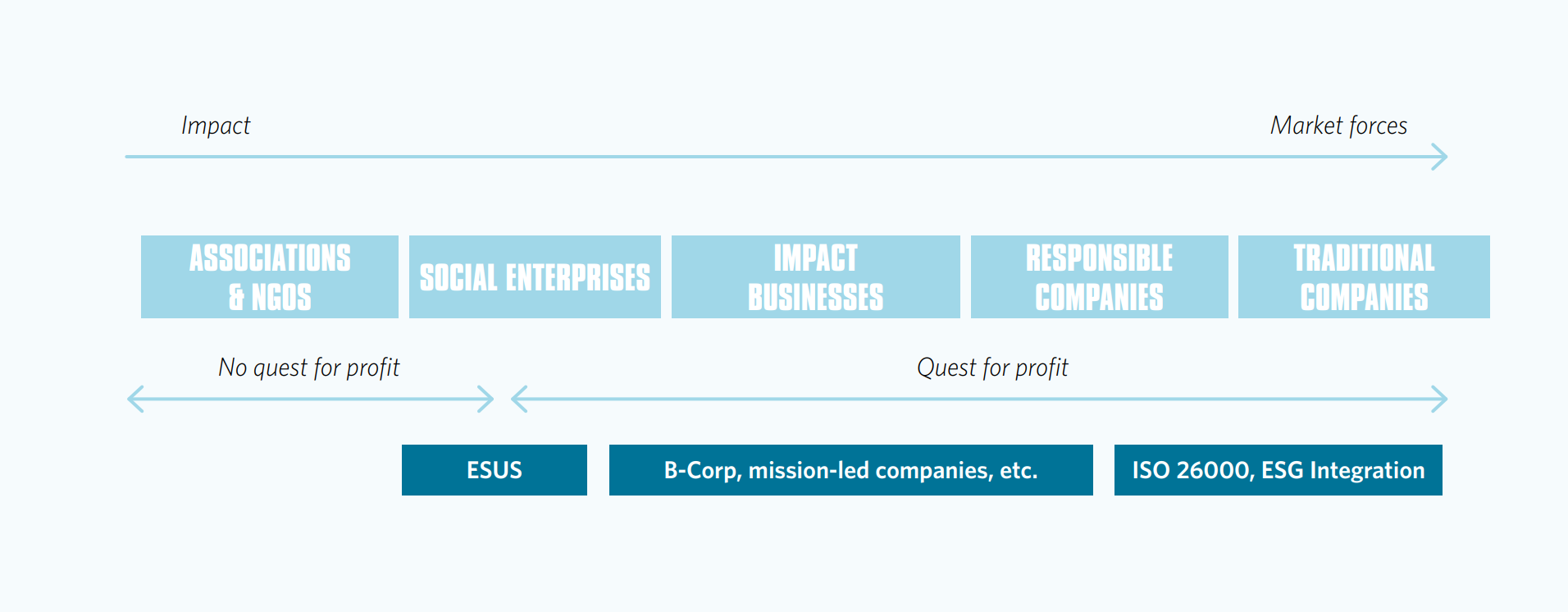
Against this backdrop, several companies have decided to go further, integrating ESG into their operations as a tool for value creation rather than management. This is because many businesses are seeking to reconcile positive impact and profitability by drawing on the environmental and/or societal benefits of a product or service. This search for impact has led to the creation of new economic and new governance models.
An early example is the label put forward by B-Corp (standing for “beneficial corporations”) introduced in the US in 2006 to recognise companies that act in the public interest. B-Corp audits companies and gives them a score, suggesting areas for improvement as regards the various aspects of E, S and G. Today, over 7,400 companies in 92 countries (including 840 in France) hold the B-Corp label. Companies like Patagonia and the L’Occitane Group have chosen this label and publish their B-Corp reports every year on the B-Lab website.
In France, ESUS (social solidarity enterprise) accreditation has existed since 2014. This recognises that a company can pursue social usefulness as a principal goal, and focus on “vulnerable groups or the preservation and development of social ties, education in citizenship, sustainable development, the energy transition, the promotion of culture or international solidarity.” This accreditation lays down a number of rules, particularly regarding pay, and mainly seeks to restrict a company’s activities. This prevents the accreditation from encompassing all sectors of activity.
So in 2019, the “mission-led company” status was introduced to recognise companies wishing to make solutions for social and/or environmental issues central to their corporate model, while reflecting the interests of all stakeholders.
In 2019, France introduced this new legal status with the PACTE Act, allowing companies to publicly affirm their raison d’être and several social and environmental goals. Today, 1,266 companies have stated their missions. One example is CAMIF; another is MAIF, which recently published its first mission report. This illustrates the five pillars of the mission model and highlights concrete actions: the opening of a MAIF Campus for training staff in the insurance professions, the certification of its buildings in line with stringent environmental standards (Breeam In-Use, HQE) and the absence of bonuses and individual variables paid to teams.
Another example is Crédit Mutuel, which has formalised 15 objectives since 2020.¹ Crédit Mutuel Alliance Fédérale announced the creation of a societal dividend, whereby it allocates 15% of its net income each year to financing environmental transformation and solidarity projects. This came to €523 million in 2023.
Click to open image in full screen
We will end by mentioning a new type of objective set by “regenerative” companies, which seek to repair ecosystems by taking inspiration from nature’s methods. Examples include EcoTree, which has developed a business model aimed at individuals and companies alike, which helps to preserve ecosystems through the use of nature-based solutions, and Interface, which has redesigned its American factory near Atlanta to function like a natural ecosystem, and is working on the production of genuinely carbon-neutral carpeting. The “regenerative” movement is not confined to private companies: Nestlé, for instance, has also made strides in this area.²
The common denominator of all these companies is that they have adapted their governance model to their chosen mission, and expressed this mission as a powerful raison d’être. These company models – Stewardship, Raison d’Etre, Mission-led and Responsible – have always existed, but are now increasingly structured and adapted to the many challenges facing our society.
Integrating ESG data is only the first step. The real revolution lies in companies’ ability to truly align their operations with societal aspirations, and thus actively contribute to a more sustainable and inclusive society.
Interface has redesigned its US factory near Atlanta to function as a natural ecosystem, and is working on the production of genuinely carbon-neutral carpeting.
Arnaud Blandin, SKEMA Business School