
#1 - JANUARY 2024

Interview : Romain Didier
The Frenchman Romain Didier worked for several years in Gabon’s forestry industry, among the age-old trees of the world’s second largest forested area after Amazonia. Though he assures us that it is “relatively well preserved” today, his experience with SOMIVAB (timber development society) has led him to think long and hard about this underused material and solutions for turning this activity into a sustainable industry.
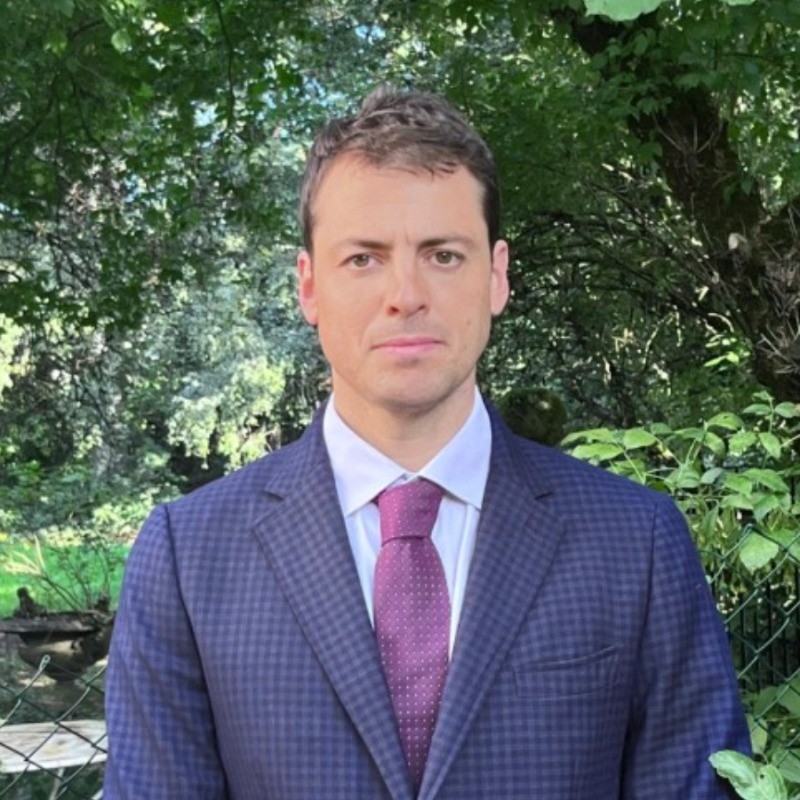
Romain Didier
Somivab
“In Gabon,
65% of trees
go to waste”
Seen from Europe, it’s hard to imagine Gabon’s forestry industry complying with environmental standards.…
I can understand that. Logging is an activity that causes a great deal of destruction to an environment. Sometimes it involves primary forests, centuries or even millennia old. We destroy and move on to the next spot. We operate in around 450,000 hectares of forest, and are constantly on the move. The destructive events are therefore extremely short-lived. What we destroy in a few months took centuries to grow. But we only use a small part of what we destroy.
You’re saying that most of the wood cut is not used?
In Gabon, in particular, the log conversion rate is around 35%. This means that 65% of the trees goes to waste. As Gabon is lagging behind in its development, this waste is generally burnt. On top of not being used, it is burnt, thus generating more emissions. The trunk is removed from the log. This trunk has to be sawn up, and then the products are processed, and this involves problems with interlocked grain. If people want 5-metre lengths, 4-metre pieces just go on the fire. It’s a gigantic loss: millions of cubic metres of wood each year.
As well as the obvious environmental impact, this waste must have a huge effect on costs…
That’s right. Wood is expensive mainly because there’s a very low yield from the resource. Scarcity is less of an issue. There are no economies of scale, since two-thirds of the material is simply burnt. We succeeded in developing some interesting product mixes that enabled us to exceed average yields, but we were still a long way off.
This is not the case in Europe or North America, where we manage to use almost all of what we exploit. The difference here is that forest management is not at all similar. A lot of trees have been planted in Europe. But these plantation forests don’t have the characteristics of real forests; there are problems with soil acidity, very little biodiversity, and we work with one or two species. They aren’t forests so much as fields of trees.
The tropical forestry business is often denigrated, and it’s true that there are a lot of problems with illegal logging, production and so on. But it’s important to remember that the largest forest owners in Europe are helping to create standards in this sphere. In Europe, wood can be used efficiently because the species make this possible. Conifers, in particular, generally grow quickly, grow straight and are easier to manage. When a tree grows more naturally and you’re working with multiple species, it’s more difficult.
Wood is expensive mainly because there’s a very low yield from the resource.
Scarcity is less of an issue.
Romain Didier, Somivab
Depending on the purpose for felling a tree, you might also wonder how far you are ESG-compatible?
A tree can generate different types of value. The important thing is to succeed in dividing it so as to multiply this value. Some of today’s uses are not the right ones.
In south-east France, there are energy plants that use biomass: forests are planted, razed and entirely burnt. But if you fell a tree and use it all for biomass, you’re probably losing pieces that could have been used to make furniture lasting 50 years, or structural timber.
Biomass is a very good practice when you can do nothing more with the raw material. But there is no advantage in planting forests to produce biomass. The primary purpose of the forest is to provide a home for wildlife and protect biodiversity. But in those forests, there is absolutely none of this. So it’s not virtuous.
Doesn’t being more environmentally virtuous also mean cutting down fewer trees?
t’s not that simple. There is consumption, i.e. how products are used and how long they will last. It’s important to consider the question of “regeneration time versus useful life” cycles. Human society in general involves extremely linear, forward-moving development, whereas in most cases, nature is cyclical. The time it takes to consume and destroy things is out of sync with the time it takes for them to recreate themselves.
In this context, the forestry industry is relatively virtuous, because we have fairly close cycles between reconstruction and consumption. With furniture or houses, for example, the cycles between natural regeneration and the period of use are quite similar. So there’s a certain rationale in felling trees. Now if instead of using the resource well, we use it badly, it can be a problem.
How can Gabon’s timber harvest be made more profitable?
This is an area of great biodiversity, with a huge number of endemic species, both plants and wildlife. So our first thought was: perhaps the timber industry alone can’t make the most of all the forest resources, so how can we combine various solutions to achieve the near-total use of resources?
The example of the road networks is very interesting. A huge number of roads are created, and this is one of the main activities in forestry, because we’re always on the move and we have to transport the wood. But these road networks are only used for a very short time, whereas they could very well be used afterwards for other things and become permanent.
Developing agroforestry, for example, is socially beneficial. Activities would be spread over the entire area where forestry operations are carried out, which would inevitably generate jobs and activity close to villages and small towns, rather than concentrating value or employment in one area. A social balance could then be established.
What’s stopping this kind of initiative?
There’s a lack of willpower. In Central Africa’s forestry industry, economic operators are often asked to take on the responsibilities of its absent State. My point of view has always been that the positive social impact of companies must come from sound operation. I don’t think it’s the responsibility of companies to install drinking water networks in villages. On the other hand, having virtuous businesses that generate enough jobs, income and taxes in towns and villages so that the authorities can continue to develop remote areas – yes, definitely.
But the size of the companies also plays a part. Many of them are run by families, individuals or small groups: they see things on their own scale and don’t see why they should bother carrying out complicated projects that might not work. They have their businesses, which work well for 10, 15, 20 years, and that’s fine with them. What happens afterwards is of no interest to them.
There is no advantage in planting forests to produce biomass. The primary purpose of the forest is to provide a home for wildlife and protect biodiversity. But in those forests, there is absolutely none of this.
It’s not virtuous.
Romain Didier, Somivab