
#1 - JANUARY 2024

The ground has been laid
Fabien Seraidarian
Director of Knowledge Transfer and of SKEMA Global Executive MBA, SKEMA Business School
The advent of the social impact company
While the acronym ESG is now established as a way to express the challenges of the Anthropocene, the study of acronyms is very revealing, reflecting different representations and rationales for action, as witness the categorisation used in the thought process.
The language and terms used influence our approach to the issues we face, and stakeholders often find themselves at loggerheads. In the political sphere, after regulatory legislation, ecological planning responds to the urgent issue of climate change. The same applies to the organisation and approaches implemented within a company, as shown by the analysis carried out, including the development of terminology and organisation (positioning, skills structuring, governance, etc.).
These conceptual changes are found in not only emerging academic fields, but also the development of communities (Weick, 1995). Literature on innovation and sustainable development has introduced several ideas like “eco innovation”, “green innovation” and “sustainable innovation” in different communities and geographical areas, leading to subtle differences in understanding and generating highly varied viewpoints and practices (Franceschini et al. 2016). The evolution of ideas and acronyms and the development of concepts help us to grasp the complexity of the pathway.
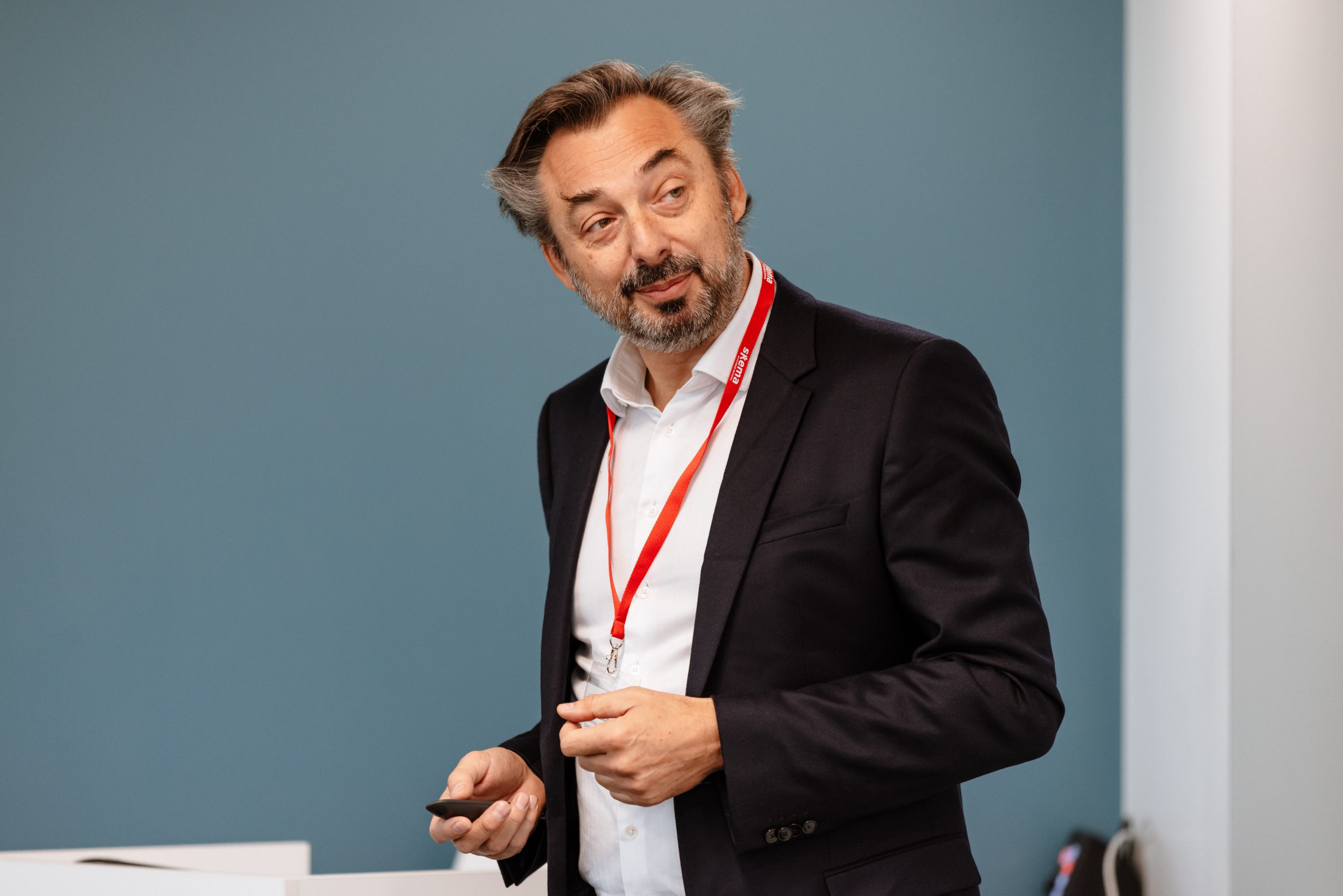
Though categorisations differ, three approaches seem to be at work: the sustainable company, the contributive company and the regenerative company:
ESG is a long-term undertaking, despite the desire and the need to achieve tangible results as quickly as possible.
Fabien Seraidarian, SKEMA Business School
ESG raises the question of value creation. It has long been established that it goes beyond shareholder and financial value, but characterising the forms of value creation means developing tools and calculation methods to provide metrics, so that reports can be made on the actions taken. How can a full picture be given of the social initiatives and innovations introduced by businesses? How can the impact on the planet of changes in the consumption of goods and services be assessed beyond the “simple” reduction of the materials used?
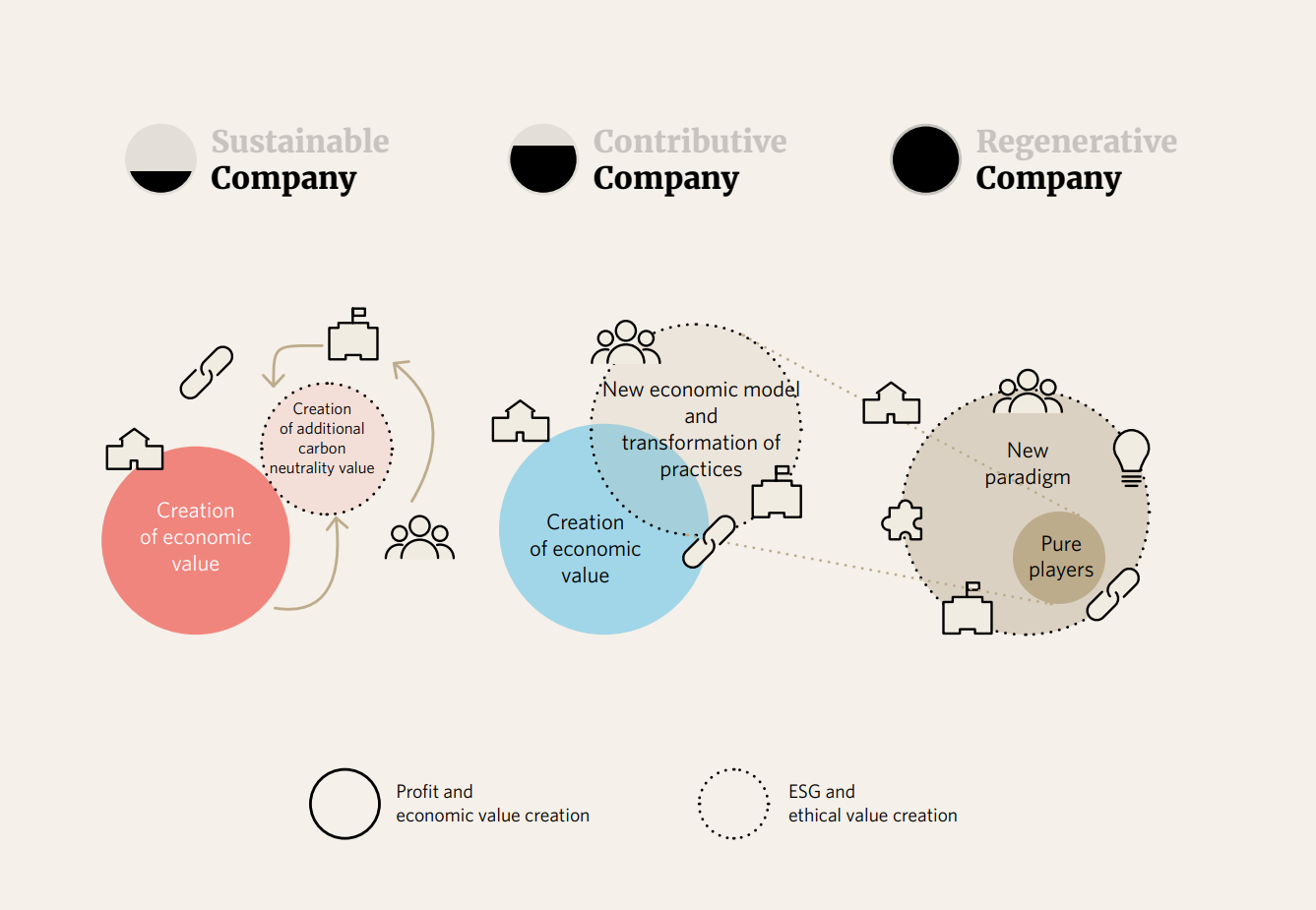
Yet there are more and more benchmarks, which can also be based on historical debates that seek to go beyond GDP as an indicator of wealth creation measurement. The various categories distinguish between the types of value creation. Here we can stress that there is a difference between economic value, which can benefit from strategic choices aimed at greater sustainability, and ethical value creation, which covers value creation forms arising from ESG initiatives involving environmental impact (reforestation, soil regeneration, etc.), social impact (impact on well-being and health) and governance (e.g. an institutional impact for the development of common goods).
Click to open image in full screen
The diagram shows how value creation is structured according to the model. In the regenerative company approach, a distinction is made between “pure players” , i.e. native firms committed to a more beneficial ESG approach that is part of their DNA, and contributive companies that may seek to incubate structures, to create experience effects supporting the dynamics of transformation.
ESG is the result of a dialectic between the social and business spheres, and is becoming a (macro) process. The dynamics of the ecosystem are decisive: the role and position of stakeholders
co-evolve with the company.
Fabien Seraidarian, SKEMA Business School
This categorisation reveals several fundamental questions about the processes at work in the organisations we talked to.
ESG is the result of a dialectic between the social and business spheres, and is becoming a (macro) process. The dynamics of the ecosystem are decisive: the role and position of stakeholders co-evolve with the company. Key players like non-governmental organisations, market organisations and federations, customers, suppliers, higher education and research institutions and agencies enable companies to move forward, push back the boundaries, develop new practices, devise new business models and give credibility to a raison d’être and mission in harmony with the living world. It is worth noting that the customer’s role is becoming more activist, enabling the economic sphere to be reconciled with society. NGOs in various spheres are taking both a political and a technical approach in supporting players in the different sectors. Suppliers are encouraged to turn the prevailing rationale on its head, take the initiative and show leadership as regards their principals, shaking up the hierarchy of value chains. Higher education and research institutions help to give meaning to technology and play a decisive role in innovative initiatives. ESG can thus become a major collective project, at least at the level of ecosystems, industries and regions.
Click to open image in full screen