
#5 - NOVEMBER 2025


Google Cloud : The cloud, the spinal column of globalisation
By enhancing data, automating processes, securing usage, accelerating the adoption of AI and supporting sovereignty, Google’s cloud has become an amazing machine, serving businesses and the global digital economy in general. In 2025, Google Cloud is a technology player that enables businesses and administrations to take full advantage of artificial intelligence, from its infrastructure to its latest agentic AI solutions.

By Antoine Boitez
Data: transforming a mass of information into intelligible material
Long restricted to simple storage and computing power, the cloud infrastructure is now the bedrock of international digital transformation. It involves complex mechanics that foster companies’ productivity and competitiveness. For Anthony Cirot, Google Cloud Vice President of EMEA South (a huge area encompassing Benelux, France, Spain, Portugal, Italy, North Africa, Israel, the Middle East and Turkey), the heart of technological innovation lies in economic players’ ability to take dormant data and make them readable, useful and mobilisable by and for artificial intelligence, thus turning these data into a competitive advantage.
Every AI conceals a wealth of data
This is the whole point of the “data lake”: a term describing spaces where data coexist and where it is possible to unify, structure and, most importantly, interpret them. “Companies’ data are still too often stored on employees’ workstations, creating silos and scattered pockets of data that prevent them from being used to their full potential, let alone applied to AI models on a large scale. So the first step is to centralise these data in a data lake that securely unifies and consolidates all commercial, marketing and operational information,” says Anthony Cirot.
Without quantitative, qualitative, accessible data, AI is like a rocket without fuel: promising on paper, but unable to fly high and far, or help businesses transform, prosper or even survive. This paradigm shift is disrupting organisations from top to bottom: the former power of centralised data is giving way to a strategy of access and speed. Time thus becomes a competitive advantage in a globalised economy where every tiny figure can make a difference.
AI in full swing…
While AI is evolving at a global rate, its uses vary considerably across regions, groups and cultures. With Google, it is a matrix, present throughout the entire catalogue of services. Integrated into Google Workspace and Cloud offerings, it drives usage, and includes automatic content generation, translation, data analysis, vulnerability detection and code optimisation. ‘We are shifting from a promise-based economy to an economy of implementation,” says Cirot. Generative AI can enable faster deployments, modernise ageing infrastructures and create new services in record time, while enhancing human skills and capabilities. “It creates levers for unprecedented productivity, including for small organisations,” says the Google Cloud VP.
There are ever more use cases, including marketing, customer relations, cybersecurity and code management. And the boundaries between products, services and experiences are becoming porous. One Google Cloud customer, Air France–KLM, is working to make its data more accessible across the group and thus manage its offerings and services more effectively. LVMH, another strategic client, uses Google’s cloud infrastructure to stay at the cutting edge of innovation and offer increasingly customised experiences through AI. These two groups, both global players representing European expertise, rely on a partner that is itself global: with its interconnected data centres and submarine cables, Google Cloud offers a global digital infrastructure that meets requirements for consistency, performance and minimal latency, enabling the best possible use of AI. Whether the end user is in the USA or Paris, the promise is the same: a consistent, fast, resilient experience.
A must: sustainable performance
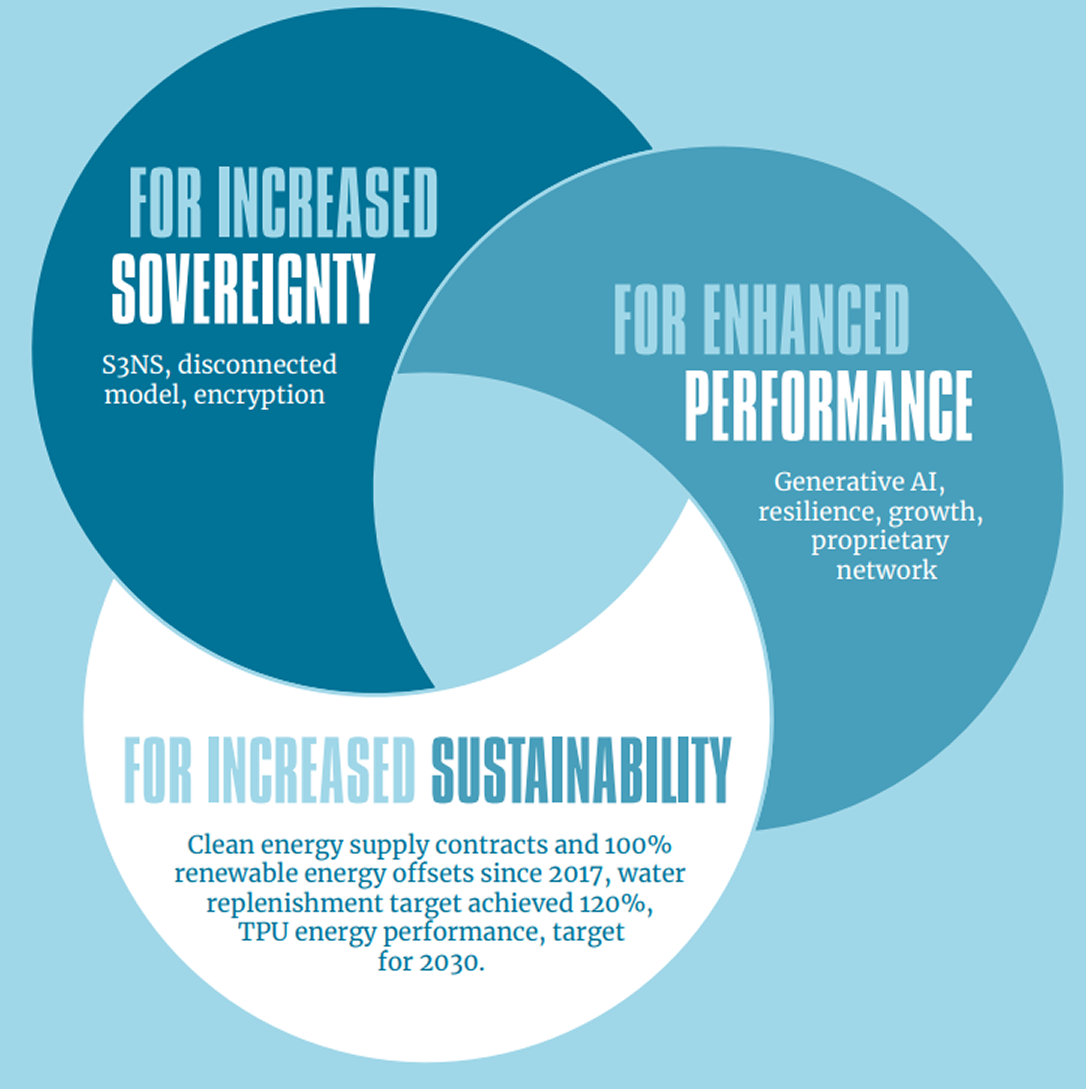
Environmental issues are central to Google’s strategy and thus to Google Cloud. The company designs its infrastructures and components with restraint as a priority. The result: six times the computing power for the same energy consumption in just five years. This has meant 100% offsets in renewable energy since 2017, notably through contracts with energy companies around the world, and continuous innovation in data centre cooling methods and eco-designed electronic components.
“We have a simple goal: reducing our footprint while increasing available computing power,” says Cirot. To achieve this, Google manufactures its own more energy-efficient processors, and adapts the use of energy according to its temporal and geographical availability. The ambition here is to achieve permanent net zero emissions everywhere in the world by 2030.
Meeting the requirements of digital sovereignty
Google Cloud also adapts to local legislative frameworks. From Europe’s GDPR to France’s “Cloud at the Centre” strategy, Google Cloud offers tailor-made technologies (particularly through encryption key management), localises its services and creates governance models in line with authorities’ requirements. This offering strategy is part of a responsible approach to technology, with audited infrastructures and strict data access control compliant with legislation, no matter how stringent. In France, Google Cloud has formed a partnership with Thales. This has led to the creation of S3NS, a company incorporated under French law providing a trusted cloud service, to be SecNumCloud-certified by ANSSI by the end of the year. This strategy is also found in several European countries, including Belgium, Spain, Italy, Luxembourg and Germany. Objective: to reconcile sovereignty, innovation and performance.
42
Cloud regions
worldwide including 10 in the EMEA South region
34
investments in submarine cables around the world to ensure Google Cloud’s global connectivity
100
%
renewable energy since 2017
0
Emission
net of operations
Target for 2030
43,2
billion
in global turnover
for Google Cloud in 2024
+90
%
of AI unicorns
use Google Cloud