
#5 - NOVEMBER 2025


Saint-Gobain an other globalisation is possible
For decades, globalisation imposed itself as a competitive imperative, driven by a race to lower costs and the relocation of industrial activities to Asia. Yet the COVID-19 crisis exposed the limits and vulnerabilities of this economic model. Faced with this shift in global awareness, the French industrial group Saint-Gobain, a world leader in light and sustainable construction, offers a compelling alternative.

By Antoine Boitiez
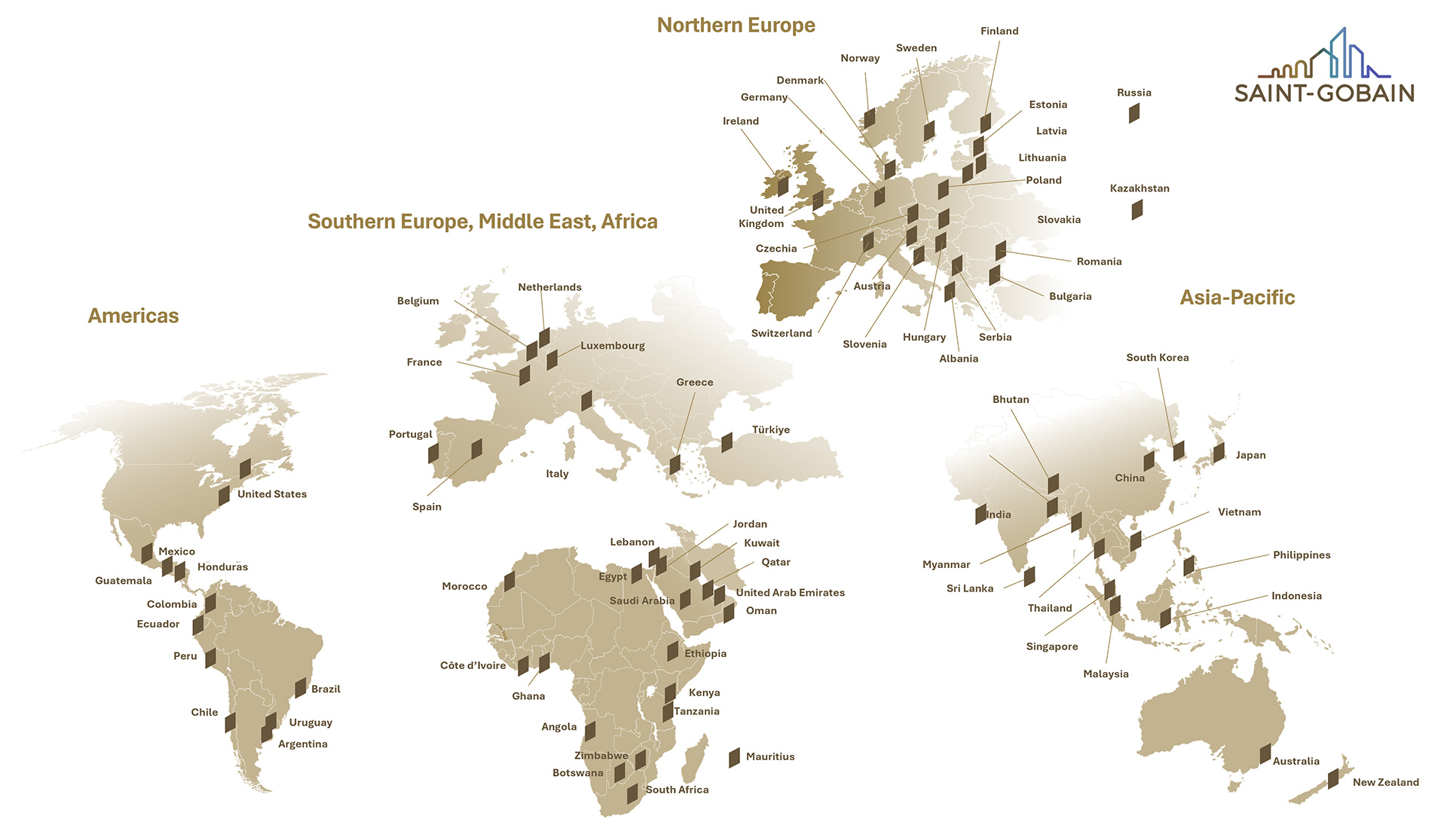
Because of the high logistics costs associated with products that are light yet difficult to handle, Saint-Gobain has long prioritised a proximity-based strategy. “Our products don’t travel well. Beyond a certain distance, they lose competitiveness,” explains Javier Gimeno, who served as the group’s CEO in Asia Pacific for many years and later in Latin America until mid-2025. In major markets such as China and Brazil, the vast majority of sales come from local production. This approach has proved highly effective in absorbing global disruptions.
This industrial set-up enables Saint-Gobain to react as closely as possible to market realities. The model relies on decentralised decision-making: regional teams are empowered to act quickly and adjust to their specific markets. “In a globalised world, we need the intelligence, speed and sensitivity of local teams,” says Javier Gimeno. According to him, this approach gives the group greater agility.
Proximity is supported by significant local industrial and commercial footprints, which combine flexibility with global consistency in innovation, safety, operational excellence and corporate values. Being part of a global group gives Saint-Gobain the strength to invest, accelerate development and support acquisitions. At the same time, autonomy is given to local entities so they can remain responsive to their markets. A stable global framework exists, but each country – from France and Italy to China, India or Brazil – adapts innovations to its own context. These adjustments improve both efficiency and competitiveness.
“We follow the rules, but we know how to listen to reality on the ground,” says Javier Gimeno. Local teams contribute their knowledge of markets and collaborate closely. Decisions are ultimately based on this shared intelligence. This balance between global structure and local autonomy ensures coherence across territories while protecting the group’s culture and values. “When we open a site in the United States or in China, we cannot abandon our culture, our values or our way of working,” he adds.
TARGETED ACQUISITIONS, NON-NEGOTIABLE VALUES AND UNIVERSAL STANDARDS
Rather than relying on mass relocation, the group focuses on targeted acquisitions to strengthen its presence and support long-term strategy. Two criteria guide these decisions: alignment with Saint-Gobain’s values and a technological or geographic fit with the company. This approach enables the group to build an ecosystem where complementarity becomes a strategic asset.
By integrating companies that bring strong skills and cultural alignment, Saint-Gobain creates coherent, durable partnerships. Values and organisational culture are reaffirmed with every acquisition. Each company joining the group contributes to reinforcing the quality of its industrial and commercial offering. Local teams align both with the global strategy and with local constraints, which strengthens operational responsiveness across regions. Shared ways of working, a consistent operational model and strong local decision-making capabilities emerge across the network.
RISK DISTRIBUTION AND CONTINUOUS ADAPTATION
After the COVID-19 pandemic, Saint-Gobain revised its supply strategy by reducing dependence on external sources to ensure greater stability in logistics flows. These decisions strengthen the group’s long-term resilience. This reindustrialisation approach expands production capacity and reinforces supply chain stability. It provides the flexibility needed to adjust in real time and distributes risk more effectively across operations. Today, the group monitors its entire value chain closely in order to anticipate tensions and strengthen strategic autonomy.
SERVICE, THE CORNERSTONE OF CUSTOMER RELATIONS
Beyond products, services play a crucial role. Logistics support and technical expertise are central in meeting customer expectations. Saint-Gobain develops comprehensive, customer-centred solutions. This strategic orientation is increasingly essential. Understanding international supply chains, anticipating tensions and securing the value chain have become indispensable skills, notes Javier Gimeno.
A COMMITTED ACTOR AT THE HEART OF TERRITORIES
Saint-Gobain is fully aware of the economic and social role it plays in the regions where it operates. The group invests in employment, training and improved living conditions. Its commitment includes ecological transition initiatives and support for vulnerable communities, as seen in Venezuela. These actions reflect a long-term vision based on partnership, presence and positive impact within local territories.
NEW SKILLS TO FACE UNCERTAINTY
In an increasingly unpredictable world, Saint-Gobain invests in managerial skills capable of steering transformation, interpreting complex environments and acting within uncertain contexts. Strengthening management teams and attracting new talent are key to maintaining competitiveness. The group develops expertise that is essential today: reading international dynamics, anticipating tensions, securing supply chains and supporting long-term strategic decisions.
Slowbalisation
Towards a more selective globalisation
What Saint-Gobain embodies aligns with a broader global evolution: a slower, more selective and more strategic form of globalisation. This transformation is driven by geopolitical tensions, rising energy prices, environmental imperatives and the vulnerabilities revealed by the COVID-19 crisis.
Slowbalisation redefines growth through industrial investment, innovation and the optimisation of regional value chains. In this new form of globalisation, companies seek resilience rather than relocation. For a group as international as Saint-Gobain, the challenge lies in maintaining global coherence while strengthening regional networks.
Slowbalisation does not mean withdrawal. It marks a new balance: one based on long-term industrial development, innovation and controlled environmental impact, reinforced by a positive social footprint.
As Head of the Latin America region for Saint-Gobain from 2021 to 2025, Javier Gimeno combines a global outlook with deep local anchoring. With decades of international experience within the group, he shares his perspective on the evolving nature of globalisation, the role of innovation, and the structural transformations that enable a 360-year-old company to stay agile. Interview with a leader convinced that “a different kind of globalisation is possible”.
Comments collected
by Antoine Boitiez
You’ve led several regions for Saint-Gobain.
What makes Latin America different?
Our products require proximity. Producing far from the market means losing competitiveness. This naturally led us to build local factories, close to our customers. It’s also a strategic choice: construction is a deeply local industry — each country has its own regulations, practices, and constraints. I’ve seen, both in Asia and Latin America, how offshoring has driven development. But its limits have also become clear: job losses in industry, environmental costs, and weakened sovereignty. The COVID-19 crisis revealed how fragile distant value chains can be. This is not the end of globalisation, but a fundamental shift.
How is Saint-Gobain adapting to this shift in globalisation?
Globalisation isn’t disappearing — it’s changing form. It’s becoming slower, more selective, more strategic. This is a deep transformation. The companies that will succeed are those able to combine a global mission with precise local adaptation, secure their value chains, and develop a broader understanding of the world. That requires new skills: understanding geopolitical dynamics, navigating uncertainty, and innovating locally without losing sight of a wider strategic vision. At Saint-Gobain, our decentralised organisation is clearly designed for this. We’re ready for this next chapter of globalisation.
Does innovation remain a central driver for Saint-Gobain?
Absolutely. Innovation is a key driver of our profitable growth, but it must be tailored to local specificities. Our research programmes are designed globally, with strong cross-functional collaboration, but their implementation is grounded in the reality of local markets. You don’t build the same way in France, Brazil or China — in fact, practices can vary even within the same country. That’s why we operate R&D centres on every continent. This network allows us to adapt our solutions to local practices, cultural or climate constraints, and anticipate the specific needs of each region.