
#4 - APRIL 2025


Mitsubishi Chemical Group: Becoming global while staying true to oneself
The Japanese specialist in industrial gases, petrochemicals and thermoplastics is aiming to become a global player without losing its identity, by means of a new philosophy: Kaiteki
By Fabien Seraidarian
Director of Knowledge Transfer and of Global Executive MBA Director, SKEMA Business School
The Japanese industrial company Mit subishi Chemical Group (MCG) has embarked on a large-scale transformation in view of becoming a global company. The engineering deployed to achieve this ambition reflects both the maturity acquired and the practices used in international companies.
A PHILOSOPHY
Long seen as a communications approach, transformation management is now based on a genuine, meaningful philosophy that works to bring the corporate fabric and its stakeholders together. The Kaiteki (see below) vision at Mitsubishi relies on trust, develops team spirit and establishes a sense of belonging. Faced with the sheer size of the company, Kaiteki creates a common reference point going beyond strategic intentions. There has been much research into engagement theories: why should someone become involved in enormous transformation projects, and how? For example, the self-determination theory (Ryan and Deci, 2017) has emerged as an essential framework for understanding human motivation and well-being. It provides a model to examine the motivational foundations of personality and social behaviour, as well as the relationship between basic psychological needs and well-being, psychological fulfilment and the quality of life in general. In particular, it pinpoints basic psychological needs, emphasising how individuals aspire to competency, autonomy and relationships. These three factors are vital to growth, integrity and well-being. The Kaiteki philosophy embodies all this, as well as fostering long-term engagement among employees.
DISCOURSE ON THE METHOD
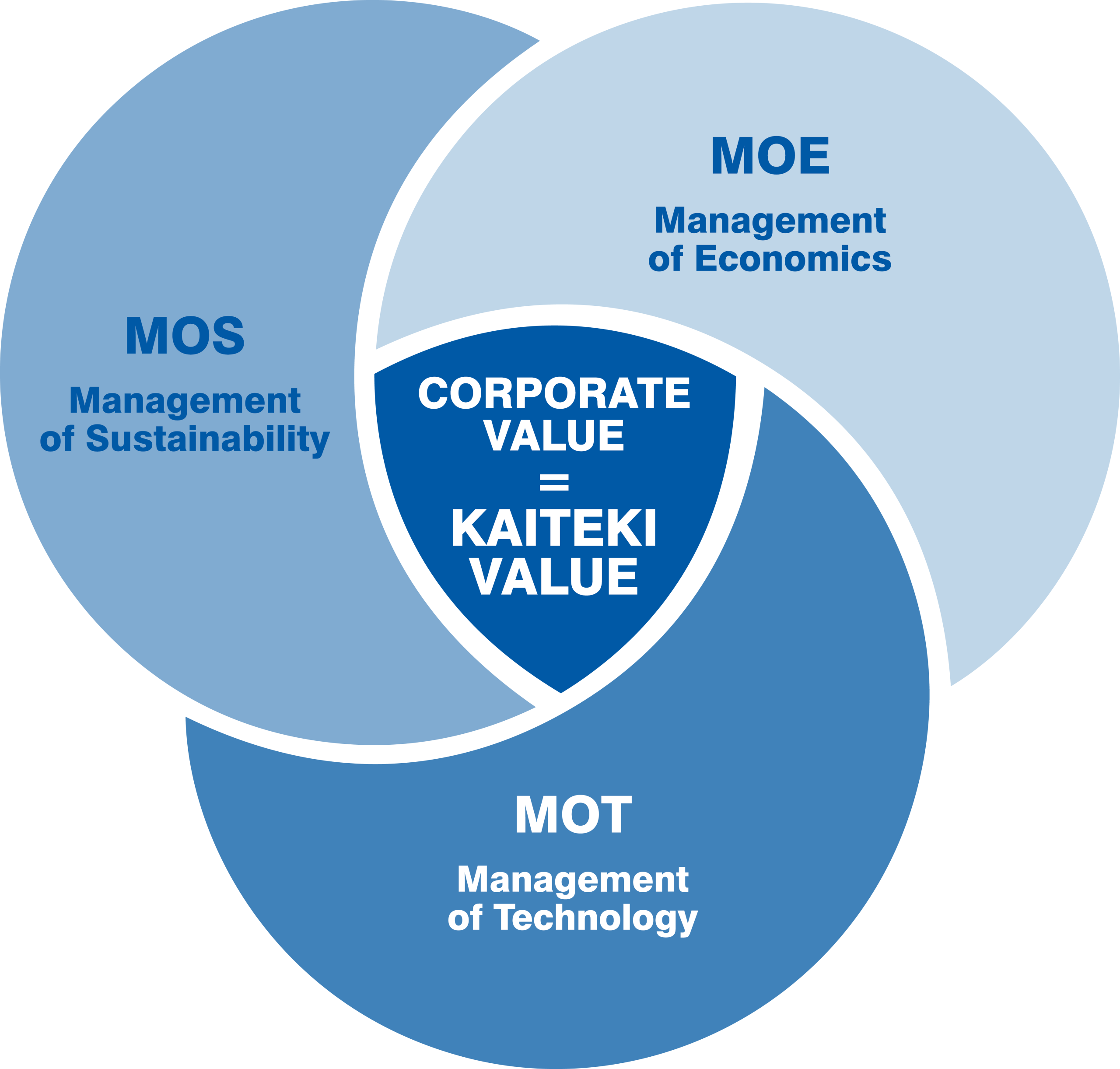
While meaning is a prerequisite for engagement, the transformation process stands as a model to challenge complexity and create a system. The stakes of sustainability imply over coming paradoxical demands and reconciling aspects that were long opposed. Conceptualising the transformation process makes it possible to take on the challenges and break free of a normative or “off-the-shelf” approach. This is a cognitive investment for the company, enabling the creation of practices and routines in order to initiate projects (often called “streams”) on a global scale: MOT, MOE and MOS (see below) are established as value-creating concepts that work together. This provides a way to move away from the organisational hypocrisy that separates the political sphere from the sphere of action within the company (N. Brunsson, 2003). This conceptualisation serves the strategy (or Mitsubishi’s purpose) and gives the company’s corporate rationale real legitimacy that goes further than “simply” tracking economic KPIs.
ORGANISATIONAL CULTURE
The Our Way transformation initiative, which is based on Kaiteki, guides employee behaviour and practices. Our Way focuses on integrity, respect, bravery, collaboration and persistence. More broadly, it shapes Mitsubishi Chemical Group’s organisational culture. It is a strategic dimension designed to engage stakeholders, build “coalitions” and rise to the company’s challenges. The company culture involves various practices and markers (rites, symbols, beliefs, etc.) and defines the company. According to K. Lewin’s model, force field analysis makes it possible to explain the driving and restraining forces associated with the impetus for change, so that the journey towards transformation can be structured or fine-tuned. This engineering activity involves questioning the organisational culture in order to understand and adapt the approach. E. Schein proposes a pragmatic and actionable model to grasp the culture via three levels: artefacts (visible and more or less legible, e.g. open space vs separate offices, a clear hierarchy, etc.); values (the principles guiding behaviour) and underlying assumptions, which are taken for granted and preconscious. Mitsubishi Chemical Group’s transformation is based on developing and promoting decisive behaviours to support the company’s globalisation dynamics, whether this involves ways of collaborating or the use of English as the working language.
This is the story of a Japanese company (turnover: $30 billion) specialising in industrial gas, petrochemicals and thermoplastics at a time of crisis for energy, the environment and geopolitics. To quote its President, this is “a new turning point” for both the Mitsubishi Chemical Group (MCG) and the whole world. To be able to influence this new environment, Manabu Chikumoto knows that his organisation has to transform, become a global player and achieve Kaiteki.
In Japanese, Kaiteki means “comfortable” or “pleasant” conditions. It is “what the group respects and aspires to”: a sustainable state that benefits everyone – the company and society alike. A kind of organisational Nirvana within “a circular economy […] protecting the planet”: it was a company with a transformation based on “well-being”.
WELL-BEING FOR
A NEW BEGINNING
« We are wholeheartedly continuing on our path towards achieving Kaiteki, the well-being of people and the planet »
Manabu Chikumoto
Representative Corporate Executive Officer, President & Chief Executive Officer, Mitsubishi Chemical Group
THE LEVERS OF KAITEKI (TOWARDS KAITEKI)
E pluribus unum
It is well known that strength lies in unity. Since 2005, the history of the Mitsubishi Chemical Group has been one of alliances between its many entities, summed up in the slogan “One Company, One Team” and a name change from “Holdings” to “Group” in the singular (2022). The chart (see below) looks like the final table of a tennis championship where the winner is the organisation. It represents a reversal: previously, each part used to lead an activity; now, the group centralises them. “It works like a central government”, says Frank Shen, Senior Talent Manager at MCG in China. “We are moving towards a more integrated model to improve efficiency and reduce costs.” By “breaking down barriers”, its website indicates, the organisation “can quickly react to change”.
Horizontal verticality
“We have a centralised governance to implement the transformation globally,” says Frank Shen. Instigated by management, it is disseminated horizontally (or circularly: see below) and in theory uniformly, across all levels of the group. But since it comes from above, top management needed to change first. Frank Shen cites the example of the Belgian executive Jean Marc Gilson, then President & CEO of Roquette, who was hired in 2020 “to lead the transformation on a global scale”. Marc Gilson was the first foreign President & CEO of Japan’s largest chemical company and one of the few non-Japanese Presidents & CEOs in Japan.
Kaiteki thinking
Kaiteki is not just a goal: it is also a philosophy in which each employee is well-versed, so they can ensure their own well-being and, by extension, that of the stakeholders and the planet. The principles behind this thinking are conveyed to employees to “guide the multitude of decisions” they take on a daily basis and “how they interact with their peers”, to help them move forward in the same direction. A “story of integrity and respect for others” that is also based on “courage”, “collaboration” and “persistence”.
The purpose of Kaiteki is to transform the company culture over the long term and foster the emergence of new management styles: Management of Technology and innovation (MOT), Management of Economics (MOE) and Management of Sustainability (MOS). To fuel them and keep these three approaches and the organisational wheel in motion, MCG acts according to two convictions: investing in the physical, mental and environmental health of its employees, and developing distinctive competences. It is a resource-based approach that is not limited to human and financial capital. Every kind of capital – natural, social, intellectual and manufactured – is affected by the transformation.
It is at the crossroads of the Kaiteki philosophy and the “Kaiteki management system” that the company generates value: “Kaiteki value”.
Tech for good
One of the Kaiteki paths is technological innovation. What the group calls “green transformation” is essential for the global leader in thermoplastics and high-performance composites. According to MCG, “This commitment spurs us to meet environmental and societal requirements, while creating new, more lasting added value for our stakeholders.” To make a difference and contribute to this approach, MCG is repositioning its offering around quality and customisation. “We are focusing on speciality materials”, says Frank Shen – i.e. especially designed materials for client-specific applications. These tailor-made solutions support sustainability goals by increasing efficiency in sectors like aeronautics and the automotive industry.
KAITEKI: KEY QUESTIONS
Does it go down well with everyone?
You cannot order a cultural transformation to come about. “Several local entities have yet to adopt the group’s overall mindset,” says Frank Shen. “Change management is complex: introducing something new doesn’t happen all by itself. We have to educate employees about the change.” Frank Shen takes a speaking example: “The custom in many MCG territories, and even at headquarters, was to speak Japanese. But in the context of our internationalisation, the group decided to promote the use of English. Many of our Japanese employees are finding this hard to accept.” The company itself is not without its contradictions: while meetings are run in English, documents are still systematically translated into MCG’s mother tongue. “Similarly,” adds Frank Shen, “we have a centralised internal portal called Chemipal, to promote our strategy, vision, messages from management, group news and global activities like DE&I events.”
Is it leading to a new leadership?
In essence, Our Way and Forging the Future are driving change. The “promotion of diversity”, “flexibility”, “agility” and initiative-taking are high on its list of values. This breaks with “the traditional Japanese way of thinking”, which Frank Shen describes in more authoritarian and patriarchal terms: “here women traditionally held subordinate positions”; and employees followed their superiors’ orders to the letter.
How is it disseminated?
Via networks. “At regional level, we have built a transformation network,” says the Regional Talent Management & DE&I Head at MCG in China. “We have invited key stakeholders to be the champions of change.” These ambassadors act as advocates for Kaiteki among local managers.
Is it a goal or an ideal?
Both. The application of the Kaiteki philosophy is transforming Mitsubishi Chemical Group, without achieving the ideal it represents: Kaiteki involves an attitude of permanent transformation. And what if it were a model in its own right?

Tap the illustration to view it in full screen