#4 - APRIL 2025


Nexans: cable maieutics
Asking questions and uncovering the truth is the simple approach adopted by the French company to “electrify the future” of a world that has become too complex.
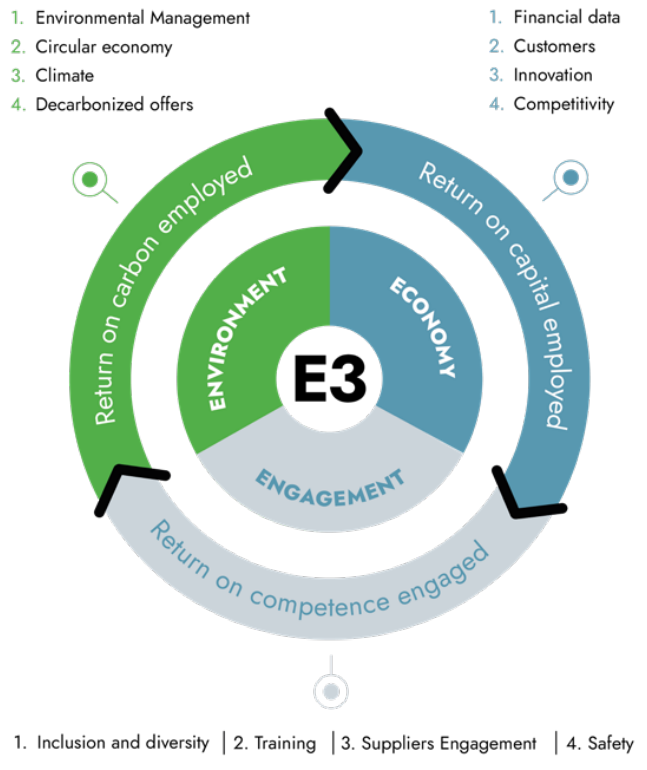
With the company’s international expansion and the diversity of customer needs, Nexans’ approach was initially based on the desire to address the growing complexity of operations. Beyond that, sustainability issues brought to light conflicting demands, which led its leaders to rethink the model more broadly, to the point of conceptualising the E3 management model. Structuring the raison d’être, this framework guides daily actions, shapes behaviours and supports decision-making. Nexans sets standards for its business to reconcile the human factor and business ethics within its ecosystem. Several rationales stand out in this transformation dynamic.
A COGNITIVE CHANGE
Kurt Lewin, a pioneer in the psychosocial study of groups, laid down the basic principles of contemporary approaches to change. When dealing with it, in order to understand psychological reactions, it is important to take it in three stages: Unfreeze, Change and Refreeze. In short, we must start by unlearning, then take the time to understand the solutions (there are often multiple causes or correlations explaining a situation) and then introduce new practices. This is the idea behind Gwenaël Gilbert’s statement: “Everything I learned in engineering school is now worthless.” Far more than a mere model, the E3 model deployed by Nexans involves a paradigm shift. What is decisive, then, is learning to unlearn: how can we break free from the inertia caused by representations, routines, operating methods, templates, tools and practices that need to be re-examined? This is a prerequisite for collectively defining a new perspective and an organisation in tune with the changing environment and the company’s vision.
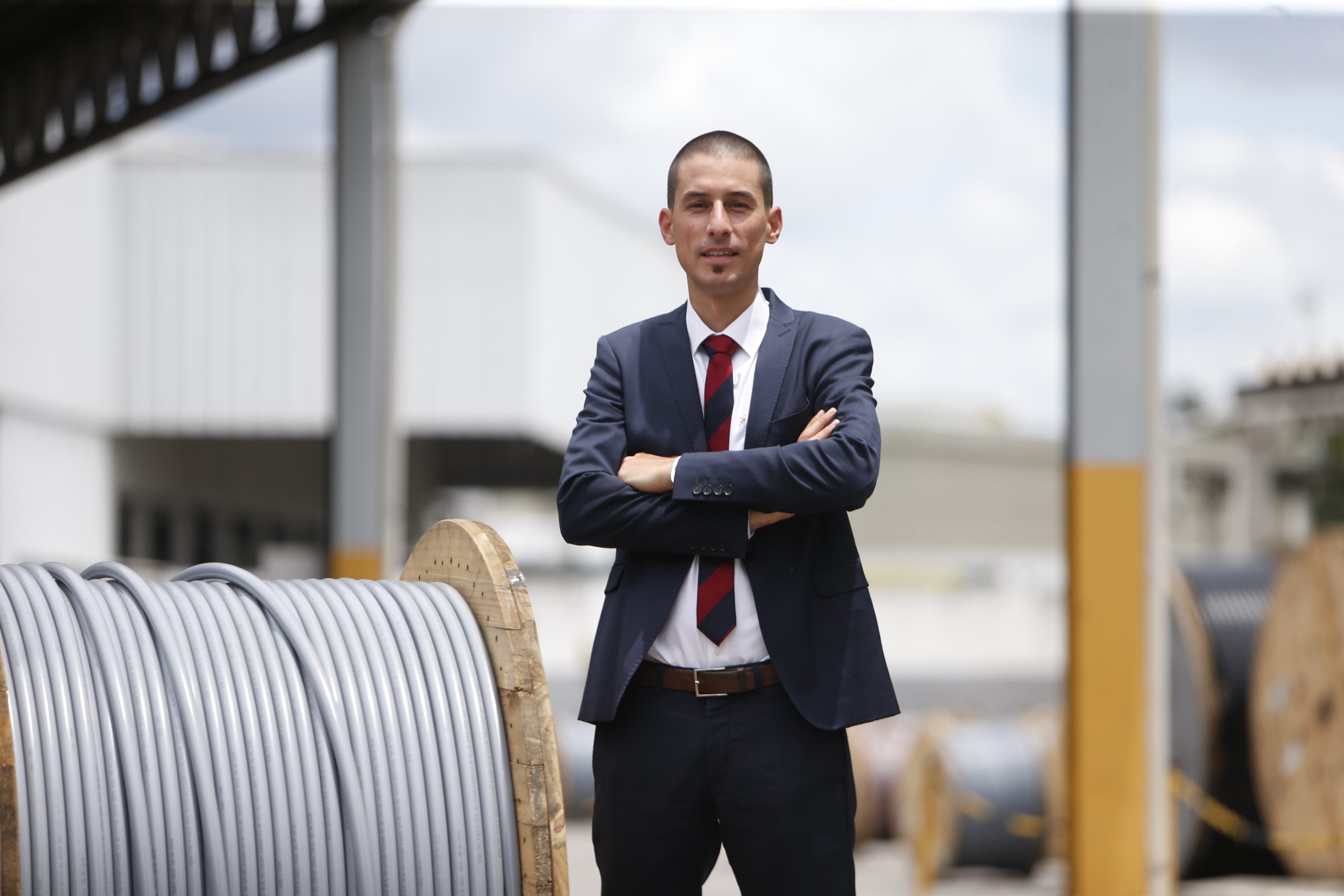
VP and CEO, Nexans Brazil
LEADERSHIP AND COLLECTIVE INTELLIGENCE
The era of the charismatic leader is now giving way to a more “distributed” form of leadership. In shaping the E3 model, Nexans CEO Christopher Guérin is exercising his leadership by proposing a new framework for action and introducing new representations and approaches for considering performance. But it is the corporate fabric’s responsibility to own this and determine how this perspective fits into the professional situations of teams and employees. Distributed leadership fosters the sharing and mobilisation of expertise at all levels of the organisation, creating the conditions for change to happen. This type of leadership promoted by the new E3 model requires high levels of trust, transparency and mutual respect. This model gives Nexans managers and decision-makers the legitimacy to exercise and develop their leadership, which is thus “distributed” and fosters greater employee engagement. Beyond the aspect of expertise, collective intelligence practices and greater interdependence between roles are developing to deal with complexity.
BETTER (A LITTLE)
LESS
BUT (A LOT)
BETTER
AN ELECTRIC CONTEXT
Nexans is connected to the world in numerous ways, through the cables it produces, the copper it recycles and the electricity it transmits, which drives data centres, wind turbines and solar farms. Only this world has entered a state of “permacrisis”. “In the past, world events were generally linear. Today, crises take many forms. They are deeply rooted, more intense, have a global impact and seem to be permanent,” says its integrated report. Gwenaël Gilbert, in Rio de Janeiro, goes even further. The VP & CEO Brazil puts it bluntly: “Everything I learned in engineering school is now worthless.” At the time, in 2005, “we were living in a world of plenty, which made it possible to imagine models of infinite growth.” But “that world is gone; we are moving into a world of scarcity.” We thus need to “learn to unlearn”, to switch to alternating current, and that is where the E3 model comes in.
A MODEL TRANSFORMATION
Introduced in 2021, the E3 model “is designed to bring about a genuine paradigm shift”, which lies at the heart of Nexans’ appropriately named transformation programme, SHIFT.
Breaking out of the paradox
“Today’s managers are torn between models that encourage them to sell more yet pollute less. They are caught up in paradoxical injunctions from morning to night,” says Gwenaël Gilbert. To overcome this, the E3 model focuses on the long-term objective: while the traditional “Western vision” will revamp a strategy at the slightest unexpected problem, Nexans’ vision turns “every crisis into an opportunity without ever compromising the longterm objective.” With the full weight of its three pillars, the E3 model compels “silos to be broken down” and “forces managers to adopt a holistic view” and “make decisions that will generate value for the company and investors – but not at any cost.”
The three “Es” on an equal footing
“Economy” “Environment”, and “Engagement”: one for all and all for one. E3 is a musketeer model: an “integrated model” where none of the three “Es” takes precedence over any other. “In recent years, we have learned to make multifaceted decisions,” says Gwenaël Gilbert. He cites an example: “In our factory in Brazil, we are introducing continuous improvement plans. What’s new this year is that all the projects submitted have to have an impact on at least two of the model’s three dimensions. If a project targets improved profitability at the expense of the other components, it will not be selected. This way, all the decisions we make are consistent.” And Gwenaël Gilbert never tires of repeating that constraint is the mother of creativity.
Keeping it simple
“When I arrived in Brazil in 2021, one of my personal goals was to achieve negative growth – i.e. not sell more, not increase my top line, and even reduce it a little.” No – Gwenaël Gilbert’s aim is not to shore up the competition. With the E3 model, in the same year it was launched, Nexans announced that it wanted to refocus on its “core business”: electrification. A decision marked by a desire to “simplify in order to develop”, and do more with less. In Brazil, Gwenaël Gilbert has broken off with half his customers. Globally, the group has reduced its portfolio from 17,000 to 4,000 customers. “It’s counterintuitive, but some customers were more profitable than others, who only generated complexity. We profile our customers, just as insurance companies do.” When the VP & CEO of the group in Brazil talks about “profitable customers”, he is not just referring to the first E in the E3 model, but to all three. “We have an indicator, the “return on carbon employed”, which tells me the financial value created for every metric ton of CO2 emitted in scopes 1, 2 and 3 for each of my customers.” In 2023, this simplification led to a 40% reduction in the group’s greenhouse gas emissions (scopes 1-2-3). At Nexans, they talk about selective growth. For a unit to grow, it must demonstrate that its project is aligned with the three pillars, without increasing complexity.
The idea of “de-growth”
While “volume is not Nexans’ objective or priority,” Gwenaël Gilbert is keen to stress that “we are a business, and we have an obligation to make a profit. A company that does not generate profits is a company that does not invest. And a company that does not invest is a company with no future.” At Nexans, they talk about ”selective growth.” For a unit to grow, it must demonstrate that its project is aligned with the three pillars. Complexity? This “slows down profitability.” Using fewer raw materials and reducing carbon emissions? This “improves profitability and increases profits.” Reducing the customer portfolio? This has gone hand in hand with a 165% increase in the order book value over three years.
Let’s electrify the world, together.
At Nexans, we believe the future is electric and it starts with you.
From connecting wind farms to powering homes worldwide, we design innovative cables and solutions across the entire electrification value chain. Engineering, installation, maintenance, recycling – we support our customers every step of the way to anticipate tomorrow’s needs. This year, our impact has reached new heights, proving that performance and responsibility go hand in hand.
Join us in building a more sustainable future. Your commitment makes all the difference.
€8.5 billion
2024 current sales
11.4 %
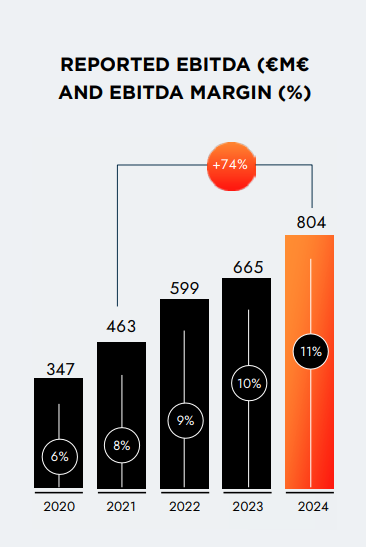
adjusted EBITDA margin
+13 %
organic growth on
Electrification activities
– 40 %
GHG emissions
reduction (full scope)
3.07 million
project beneficiaries
of the Foundation
28,500
talents in 41 countries