#4 - APRIL 2025


Edenred: an appetite for change
Beyond its adaption to a new environment, the recent history of this French company, which specialises in payment solutions for specific uses, also illustrates organisational discipline.
The first thing that comes to mind is the Ticket Restaurant meal voucher, and what it has become: a card or app you use during your lunch break.
What tends to be overlooked is what Julien Tanguy calls “the hidden part of the iceberg.” In less than 15 years, Edenred has gone from “being a voucher printer to a tech company.”
“The transformation was permanent,” adds the Chief Financial Officer of the brand with the red circle. “Ten years ago, we couldn’t have done what we do today with data or AI. We would never even have dreamed it was possible.” Edenred’s story is all about a company adept at seizing every opportunity, moving from:
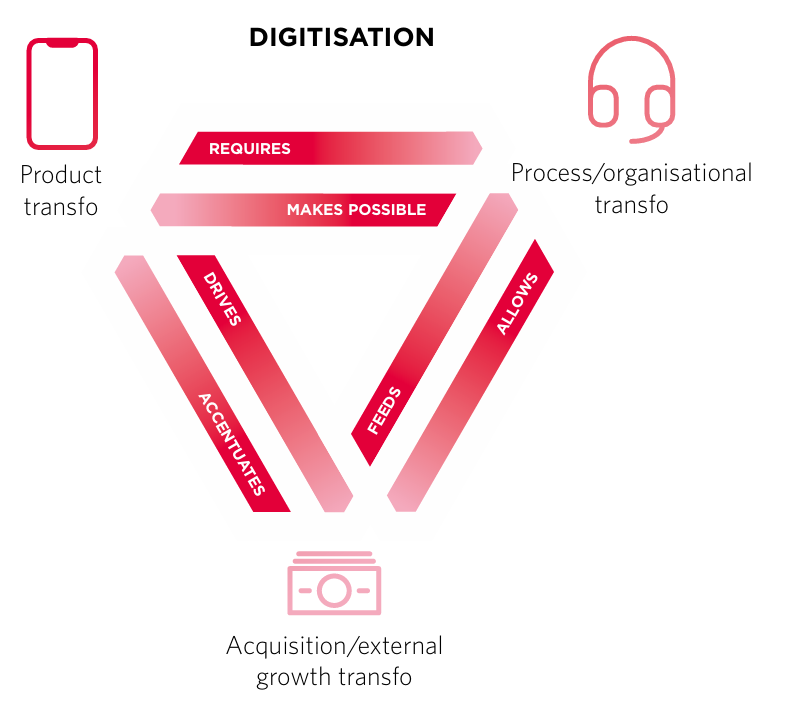
To get to this point, the French com pany has undergone a transformation on three fronts.
1962
Jacques Borel creates the Ticket Restaurant®
1983
The Ticket Restaurant is incorporated into Accor under the name Accor Services
2010
Demerger of the Accor group’s hotels and services activities: Accor Services becomes Edenred and makes digital technology a pillar of its strategy
2014
Authorisation for the dematerialisation of meal vouchers in France and creation of the Ticket Restaurant® card
2021
Launch of the 100% digital Ticket Restaurant®: a virtual card integrated into smartphones
1
FROM PLATE TO TOLL BOOTH
Everything began with its core busi ness. In 2010, Edenred embraced
digitisation and launched its first revolution in the catering industry. In just a decade, the piece of paper used to pay for a snack at the bakery next door became a card and then an app: “In 2016, mobile payment arrived in France and we were the first to move into Wallets,” says Julien Tanguy. The digitisation lunch box is open, and Edenred can feed its ambition to develop new digital products and ser vices. The company is “capitalising” on its technological investments and developing its range of payment sys tems for specific uses, serving busi nesses, employees and retailers. It is even expanding internationally: “We work with Nubank in Brazil, one of the largest digital banks in the world.
Their customers can order an Edenred tag in their mobile app to pay at toll booths. Our business lines are evolv ing,” says the SKEMA alumnus.


2
HOLDING ALL THE CARDS
“Today, we’re recruiting at Google, Amazon, PayPal and the like. We have very different teams compared with 10 years ago,” says Julien Tanguy.
Behind the visible transformation of Edenred’s products, the entire internal mechanism has evolved. New jobs have emerged: “Before these new solutions, the idea of a product manager did not exist in our company.” New working methods have become necessary: “We no longer work in V-shaped cycles. I don’t like the term, but we are more agile: we create stages of development that we review very regularly.” And the more you invest in technology, the more technology transforms you: “the development of AI and chatbots is changing processes.” Hence the vital need to support this change and offer its 13,000 employees “continuous training”. Especially since changing careers also means changing risks: “Today, the main risks concern IT security.”
For its security and its core business, Edenred remains a company that invests in itself: “For example, we own our payment platform.” But while “everything used to be done in-house,” today the company “also looks for building blocks that already exist in the market.”
3
ACQUISITION TRANSFORMATION
Its transformation into a “product” company has made Edenred a flexible, dynamic enterprise, a technological hub capable of receiving other vessels to help the group grow. “We are aiming to diversify our portfolio of activities,” says Julien Tanguy. “This can be done internally, but mergers and acquisi tions can speed up the process.” And with good reason: Edenred’s ambition is “to be the global platform of choice for players in the working world,” to quote its Chairman and CEO Bertrand Dumazy in a statement published in 2023, after the acquisition of Reward Gateway for €1.3 billion. The buyout of the British employee engagement platform specialist is “a major invest ment for us,” says Julien Tanguy. Each of these acquisitions in turn makes the parent company evolve. “In this case, it’s a product we didn’t have, some thing very different from what we were doing before. So we need to seek out new profiles and train them…”
The choice of candidates is strategic: “When you make an acquisition, you are buying three things: technology, customers and above all a team. Knowing what a technology involves is easy; a customer portfolio is a little more complicated; a team is another thing altogether. It is vital to strike a balance, and integrate the newly acquired company without disrupting growth.”
EDENRED’S TRANSFO: 3 KEY FIGURES
100%
of new solutions are
digital
Edenred demonstrates how it is transforming its value chain to meet environmental challenges, which involve the increasingly intensive digitisation of operations and the roll out of a growth strategy.
This approach is all the more speaking in that it was initiated over 10 years ago, setting a constant, sustained transformation in motion within the organisation. Its success comes from a combination of different approaches and the emergence of “dynamic strategic capabilities”.
Digitising the value chain involves understanding three aspects (Reis et al, 2018):
THE TIME OF VISIONARIES
To cope with an environment that had become unfathomable, sometimes
characterised by the acronyms VUCA (volatility, uncertainty, complexity and ambiguity) or BANI (brittle, anx ious, non-linear and incomprehensi ble), the presuppositions of strategic thinking were challenged in the 1990s. For instance, the approach proposed in the 1980s by Michael Porter, and inherited from industrial economics, was widely criticised. Alternative approaches were developed, including strategic intent and the resource based view. Up till then, the idea had been to formulate a strategic analysis under constraints, aimed initially at assessing market trends (structure/ conduct/performance model) in order to characterise the competitive advantages.
The new outlook no longer involves adapting to the environment but seeking to transform it, by modifying the key factors of success for its benefit, based on a specific management of competences and resources. From now on, the aim is to bring out the company’s purposeful leadership, with a vision that expresses dreams, immoderation or deviation from established standards.
A resource-based-view
A combination of three aspects – “technology”, “organisation” and “professions” – has enabled Edenred to transform the company and make digitisation a lever for growth and value creation. Through the use of new technologies, the value chain is freed from physical constraints and production tools can be standardised, even if it involves adapting to the constraints and expectations of different markets.
To unlock the potential of digitisation, Edenred has developed dynamic capabilities defined as “a firm’s ability to integrate, build and reconfigure internal and external resources/competences to address and shape rapidly changing business environments” (Teece et al., 1997). Various dynamic capabilities – the acquisition of technology companies to accelerate digitisation and make the value chain more competitive, support for job transformations, or the reorganisation of the firm and the impact on support functions and secondary activities like cybersecurity – have emerged and solidified over time, introducing new practices, creating routines and securing business development.
Governance and management practices
Managers play a major role in this reconfiguration of resources and competences, so that the concept of dynamic managerial capabilities can be introduced upstream (Adner and Helfat, 2003). Lastly, the emergence of dynamic capabilities relies on managers and organisational governance.
Edenred’s transformation illustrates how important it is for managers to demonstrate intrapreneurship, as well as a certain degree of anticipation combined with a keen sense of business. Other fundamental characteristics are decisive for developing these dynamic managerial capabilities: