#4 - APRIL 2025


What if we transformed our way of transforming ?
The geopolitical context, which weighs heavily on organisations, raises the question of the role of a geopolitical expert right at the heart of international companies.

By Dominique Vian
Professor of Management
SKEMA Business School
We have moved into the age of transformation. Have you noticed that this word is gradually replacing “innovation”, which had itself replaced “progress”?
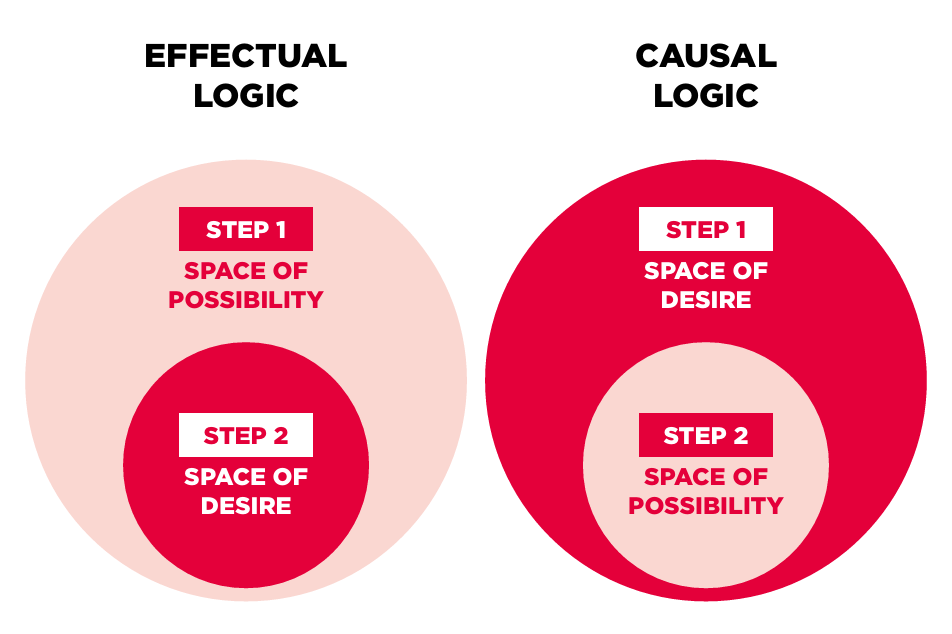
Usually, transformation starts with desires or the goals we set ourselves. Only after that do we explore the possibilities of achieving this desire. In other words, there is the space of desire and the space of possibility, and we hope that the intersection between the two is not empty. The process follows a causal logic, where desire is a prerequisite.
TAKING REALITIES FOR DESIRES
Imagine that a commercial company whose activity requires its employees to travel frequently wants to reduce its CO2 emissions (space of desire) and is looking for ways to reduce its use of high-emission transport (an event in the space of possibility). Perhaps the company could offer its employees f irst-class train tickets to encourage them to choose a more environmentally-friendly way of travelling?
But another way of thinking could be to consider the range of possibilities f irst of all. Some of the existing possibilities may be desirable. With this approach, the space of desire becomes a consequence of the space of possibility. The process then follows an effectual logic. At the outset, it is not the goal that takes precedence but the current situation, bearing in mind that every situation opens up new possibilities.
To return to the previous example, some employees may be worried about a misalignment between their desire to reduce their personal carbon emissions and their company’s travel incentives (the situation effect). The issue of misaligned practices then becomes an effect and a new challenge in the situation. And this possibility could become desirable for a company struggling to recruit young people, who are said to be more environmentally aware. The company could thus kill two birds with one stone: by rethinking employee mobility, it could also attract young talent.
This example shows that the spaces of desire and possibility are not identical, depending on the logic applied.
A PARADIGM SHIFT
This is a cognitive shift, but even more than that, it is a way of approaching transformation with several advantages:
However, certain obstacles remain. While effectuation is the logic preferred by successful entrepreneurs (Sarasvathy, 2001), it is rarely taught, whereas starting from desire predominates in all teaching and in our education. As children, weren’t we asked what we wanted to be when we grew up? The predominance of causal logic in organisations is also seen in the importance of KPIs. They are the guiding principle behind every decision. Starting from desire is justifiable, but starting from the situation you want to avoid is far less so, since you want to escape from it.
Instead of systematically starting from our desires, what if we first explored the realm of possibilities? This paradigm shift could lead us to unexpected innovations and a more meaningful future for the group as a whole. However, we will have to unlearn certain management theories, like project management, and learn new entrepreneurial theories. They have much to teach us. To transform, we must first transform ourselves. As the theologian Michel Riquet said, “We cannot do everything we want, but we can still want what we can do.”