#5 - NOVEMBER 2025


The Trump revolution, or the geopoliticisation of globalisation
Since January 2025, the world has been watching in disbelief as the international rules previously governing the world order are upended. Paradoxically, this change was initiated by the very country that established these rules. A conservative revolution?
Frédéric Munier
Professor of Geopolitics and Director of the SKEMA Business School’s School of Geopolitics for Business
We are definitely seeing the end of the period that began with the “Three Glorious Days” in the late 20th century: the fall of the Berlin Wall in 1989, the promise of a “new world order” in 1990 and the implosion of the USSR in 1991. These events thrust the planet into a new era characterised politically by the dominance of America as a hyperpower, and economically by the momentum of hyperglobalisation. The now hegemonic United States used to guarantee a Pax Americana consolidated by the opening of global markets. Democracy and free trade thus progressed hand in hand under the aegis of Washington and multilateral institutions like the UN and the WTO.
In this safer and more open world, companies could optimise their production through global value chains. Of course, horrific conflicts took place in the 1990s, like the war in the former Yugoslavia and the genocide in Rwanda in 1994, but they were perceived as remnants of the old world. Furthermore, they did not affect global companies busy deploying the transnationalisation strategies now enabled by the greater openness of former Third World countries, including China.
THE FIRST SHALL BE THE LAST
This period of optimism was short-lived. In 2001, the 9/11 attacks showed how America’s hegemony had created enemies that were difficult to fight. The US responded with the wars in Afghanistan and Iraq, engaging in a fight against terrorism in which it lost its way. At the same time, China, now a member of the WTO, underwent soaring growth: the most powerful in history. A Third World giant at the time of Mao’s death, the country had become the world’s second largest economy by 2010, and has now even overtaken the US in terms of GDP at purchasing power parity. This growth has not only enriched the country and its population, but also enabled Beijing to embark on a large-scale technological and military build-up that makes it an objective rival to Washington.
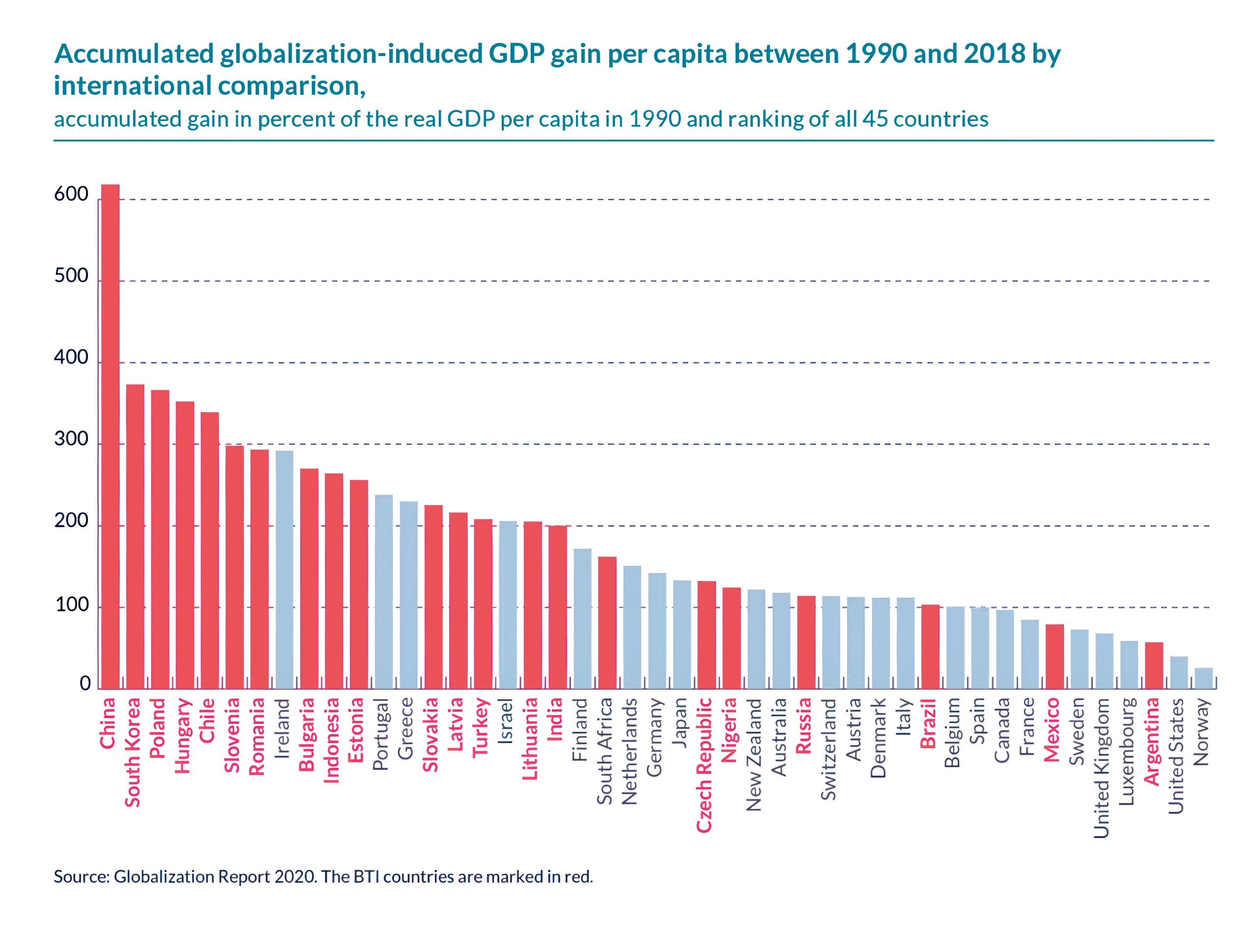
Ultimately, in one of those paradoxes that often occur in history, the globalisation initiated by Western countries has mainly benefited emerging countries. By integrating into global value chains, the latter have captured most of the gains from globalisation (see graph), leading to a spectacular economic catch-up in various countries of the global South, and a sense of decline among the middle classes in wealthy countries. This is the context in which the election and policies of US President Donald Trump should be viewed. Contrary to what we sometimes read, the new president’s decisions are not chaotic; they stem from a sentiment dubbed the “Grievance Doctrine” by economist Richard Baldwin. Trump believes “the United States has been raped and plundered by nations near and far” (Liberation Day speech) and seeks revenge against the NATO countries, Mexico, Canada, Europe, China and poor countries, all accused of weakening and taking advantage of Washington. This is why Trump is not an isolationist but a unilateralist. He believes that by breaking free from international rules that constrain the United States, he can restore his country to its former power.
THE EMPIRE STRIKES BACK
This explains his contempt for the UN, his blockade of the WTO, his abandonment of the G20, his threats to the Atlantic Alliance and his general increase in customs tariffs. Although his view of things is largely fantastical, it has sent shockwaves around the world, plunging it into unprecedented uncertainty. In only a few months, Trump has undermined the international architecture built up by his own country in the aftermath of the Second World War. In his view, this is the condition for “making America great again”. But according to many specialists in economics and international relations, the American president is accelerating the decline of the United States, alongside his total disregard for environmental issues. In other words, by steering the world into a “globalisation 2.0” or even a “post-globalisation” era, where trade flows are weaponised, Trump is helping to make the planet less safe, not more peaceful.
Given the situation, rethinking our means of action is no longer an option but a necessity, particularly in Europe. At a time when empires are making a comeback, if Europe wants to avoid being the fall guy, it will have to rethink its foreign policy in terms of both strategy and energy. On another scale, higher education establishments, particularly business schools and management training institutions, need to incorporate courses in geopolitics, geoeconomics and international political economics into their curriculums.