#6 - JUNE 2026










Olivier Dubois: “AI will never tell you it’s wrong”
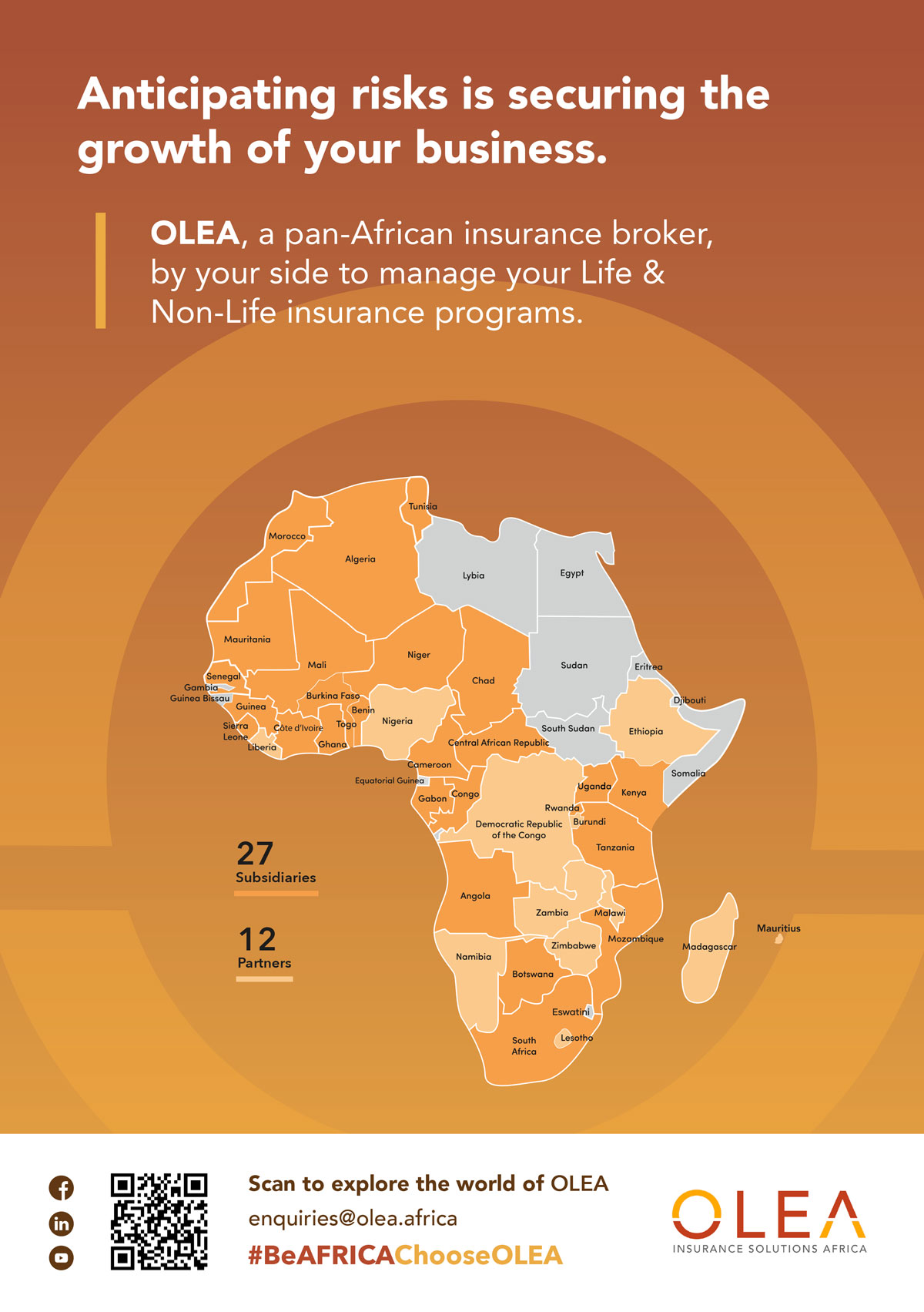
With a presence in 27 countries, OLEA Insurance Solutions Africa is a pan-African broker specialising in industrial/corporate risks and third-party health management. From this fragmented landscape with its different regulatory and political situations, its president, Olivier Dubois, has been watching the emergence of artificial intelligence (AI) in the value chain of an entire sector. While he acknowledges that “experts” are not yet on the way out, he believes their role is narrowing and their business model is still under pressure.

Interview by Antoine Boitez
Your sector has traditionally relied on human expertise. Does artificial intelligence pose a threat to this model?
It’s bringing about a huge transformation. The real game-changer is that AI is no longer just a tool for analysis or productivity. It is becoming transactional. This is where the intermediary business model is starting to show cracks.
What does transactional mean?
In early February 2026, the share prices of major international brokers plummeted. Companies like Marsh McLennan, Aon and Gallagher saw their market value drop within a matter of hours. It wasn’t due to a scandal or an operational problem. Financial analysts have come to accept the idea that AI is not merely a tool for internal analysis. It is involved in the early stages of a transaction. This means that insurance managers can now consult their own AI to analyse their policies, compare coverage, run simulations and pinpoint aspects to be optimised. In this case, the broker now only provides approval at the end: the “final furlong”, so to speak. My point is this: no one is prepared to pay for that final furlong as they would for the entire value chain.
An AI can read a contract. It cannot negotiate a claim.
So are experts now becoming validators at the end of the process?
Absolutely. They are no longer the gateway to knowledge. They confirm, they adjust, they take responsibility. Analysis can be carried out elsewhere, at an earlier stage, by the machine. The question then becomes an economic one: if the machine does 80% of the work, how can payment of the entire fee be justified? In an African environment, this validation still has considerable weight. Every country has its own regulatory framework, negotiating culture and political context.
How is OLEA responding?
We are investing in our own tools. We are developing and testing AI solutions to analyse claims, verify policies, make use of our internal data and produce summaries. But there is a real debate within the company. Some believe that AI should simply support human analysis. Others think that an expert’s reasoning should be systematically compared with that of a machine. What is so striking is the speed. Over the last six months, things have really picked up pace. New tools are appearing, each vaunting an even more effective version than the last. I must admit that we are still struggling to grasp the true extent of the upheaval.
If the machine produces the bulk of the analysis, payment becomes an issue.
Is this disruption affecting your entire organisation?
Yes. If we take a subsidiary in Africa, we find a whole chain: management, customer service representatives, account managers, claims managers, healthcare teams and medical advisers. AI can play a different role in each of these functions. It’s going to get some of the work done. Not all of it, but a significant amount. The AI won’t physically visit the client with a ready-made summary. But the client could receive you with analyses generated by their own AI. They will question you on the basis of these results. Nonetheless, in some African countries, human relationships remain central. It’s still extremely important to see people in the flesh.
Beyond the organisational aspect, you raise the question of meaning.
If we follow this reasoning through, we could say that meetings are a thing of the past. AI will analyse all the contracts, produce an annual report, and then we’ll send it to the client. But a meeting is not just about exchanging information. It’s a moment when colleagues may disagree, and we can then refine our judgement. If everyone brings their “own” AI-generated analysis to the table, we risk pitting Employee A’s AI against Employee B’s AI. In the end, nobody knows where human judgement fits in. Critical thinking, support, hierarchy, commitment: these are what shape an organisation. If AI undermines that, all that remains is an automated exchange: AI systems working remotely that communicate with other AI systems working remotely. That’s not viable.
Can AI really replace human analysis?
It produces structured, rapid and sometimes highly insightful analyses. But it will never tell you it’s wrong. It may come up with a response that is convincing and perfectly worded, but fundamentally flawed. In the insurance world, responsibility is still a human concern. If an incorrect analysis leads to serious consequences, it is not AI that will incur professional liability.
Are you concerned about the impact on employment?
I can see the potential job losses, particularly as regards the management and back-office. We’re constantly being told that new jobs will be created. Maybe that’s true. But at the moment, I can’t really see the positive side. We are both a traditional broker and a third-party healthcare cost manager. In claims management or financial operations, automation is likely to reduce staffing requirements. The question is whether we will transition these teams into roles involving analysis, supervision and quality control. For now, what I’m mostly seeing is the pressure on existing jobs.
Your business is focused on Africa. Is the revolution progressing at the same pace there?
There is a data discrepancy between Africa and the rest of the world. Some approaches, like parametric insurance based on real-time climate data, are still struggling with a lack of information that prevents them from achieving sufficient granularity. But beyond the data, there is the situation on the ground. We stand by the fact that we are experts on Africa. This means immersing ourselves in the environments where we operate, picking up on new trends, understanding the expectations of clients and investors and being aware that every country works differently. We currently operate in 27 countries; in a few years’ time, that could rise to 30 or 31. These are not homogeneous markets. AI will not replace local general managers, or claims handlers who negotiate settlements in specific circumstances. It’s all about interaction, a thorough understanding of an environment and a relationship. Our expertise in Africa will continue to be relevant. On the other hand, many of the daily tasks that enable these experts to form informed opinions will be reviewed. We are moving towards a human-AI hybrid.
A professional is responsible for their mistake. Never an algorithm.
OLEA: KEY FIGURES
Present in
27
African countries
800 to 850
employees